


Walking along the broad four-lane roads of Dhaka’s new administrative district in Agargaon, one cannot help but notice the remarkable transformation the area has undergone in recent years. Modern buildings have sprung up on either side of the road, housing numerous government offices, United Nations agencies, and various international development organisations.
However, as the afternoon wears on, the area’s bureaucratic character begins to fade. Soon after dusk, a different Agargaon awakens—one pulsing with a new rhythm of life.
As the sun sets, the air becomes rich with the enticing aromas of sizzling kebabs, spiced chickpeas, freshly baked parathas, meat bhunas, chotpoti, singaras, puris, ice cream, fresh fruit, burgers, sandwiches, vortas, and even seafood.
By twilight, this administrative hub transforms into a bustling street food haven, not driven by seasoned chefs or culinary professionals, but by fresh graduates and university students pursuing a different kind of dream.
Under the bright silver glow of streetlights, around 300 food carts stretch from the Election Commission building to the Government Music College, then veer left towards the University Grants Commission.
Food lovers from surrounding areas—particularly Shyamoli, Kallyanpur, Mirpur, Agargaon, and Paikpara—flock here in the evenings to eat, socialise, sing, and take photos, turning this once-official zone into a vibrant community space.
Of the approximately 300 food carts, most are run by students, recent graduates, or young professionals who started their ventures as hobbies or entrepreneurial ambitions.
Shahriar Sazzad stands proudly beside his modest yet neatly arranged cart, where marinated beef and chicken skewers turn slowly over open flames. A graduate in Information and Communication Engineering from Daffodil International University, Shahriar once envisioned a career in the tech industry.
‘I’ve always dreamt of becoming an entrepreneur,’ he says. ‘I started my cart by selling my motorbike about two years ago. I’m really happy with how things have turned out.’
He reports daily sales averaging between Tk 4,000 and Tk 5,000, and says the steady income is what he finds most satisfying. He adds that low salary offers, job market hurdles, and long working hours for inadequate pay pushed him to seek an alternative path.
With a loyal customer base made up of office workers and nearby residents, Shahriar says he is no longer on the lookout for traditional employment.
Just a short walk away, near the entrance to the Government Music College, the rhythmic beat of tabla practice mingles with the sound of pakoras sizzling on a hot pan.
Tanjida Afrin Nijhum, a music graduate from the college and a teacher herself, now runs her own cart. She serves rajkachuri, pani puri, chicken pakoras, burgers, sandwiches, noodles, and hotpots.
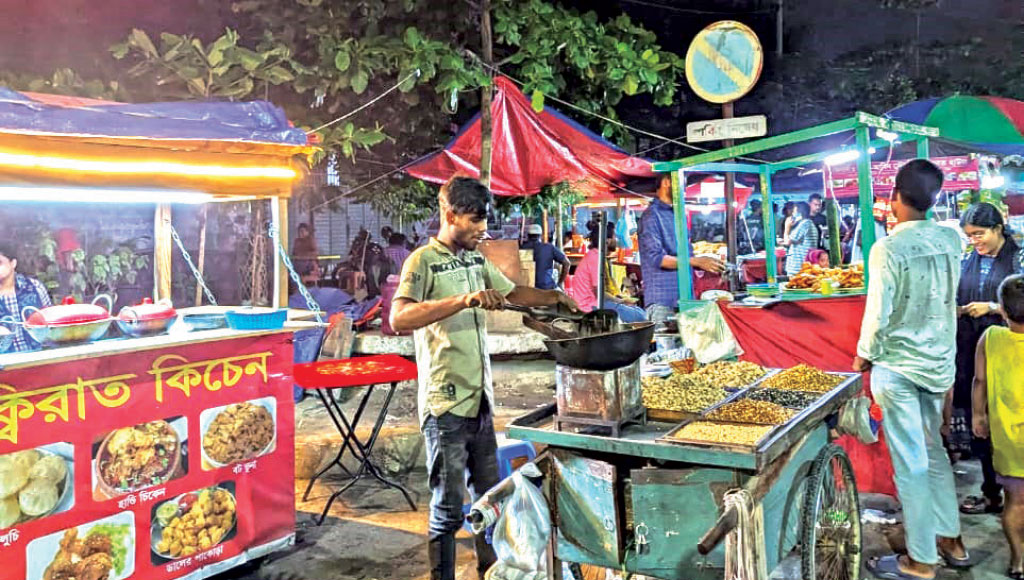
‘I enjoy cooking, and running a food cart was always a long-cherished passion of mine,’ she says. ‘What began as a hobby has turned into something more. My husband and my sister Nipun, an undergraduate at Tejgaon College, also help me whenever they can.’
Tanjida’s menu reflects her personal touch—homemade comfort food prepared without preservatives or artificial flavourings.
Meanwhile, not everyone in this thriving community is eager to be named. A young woman, currently studying Textile Engineering at Primeasia University, requested anonymity but graciously shared her entrepreneurial journey.
She typically sells bhuna dishes with rice roti, with specialities including chicken bhuna, beef bhuna, beef bhuri bhuna, and duck bhuna.
‘After finishing my university routine, I usually have a lot of free time,’ she explained. ‘Rather than spending it idly, I’ve been running this cart for nearly two years with my mother’s help.’
She admitted that balancing her studies — particularly the lab and fieldwork required for a demanding subject like Textile Engineering —can be challenging.
However, she’s managed to strike a balance.
Running her food cart has allowed her to cover her educational expenses as well as contribute to her family’s household income.
Despite her success, she expressed concern over recent enforcement actions by Rajdhani Unnayan Kartripakkha (RAJUK) targeting unlicensed street vendors.
‘The customer response has been wonderful,’ she said. ‘But I worry every day whether we’ll be forced to shut down.’
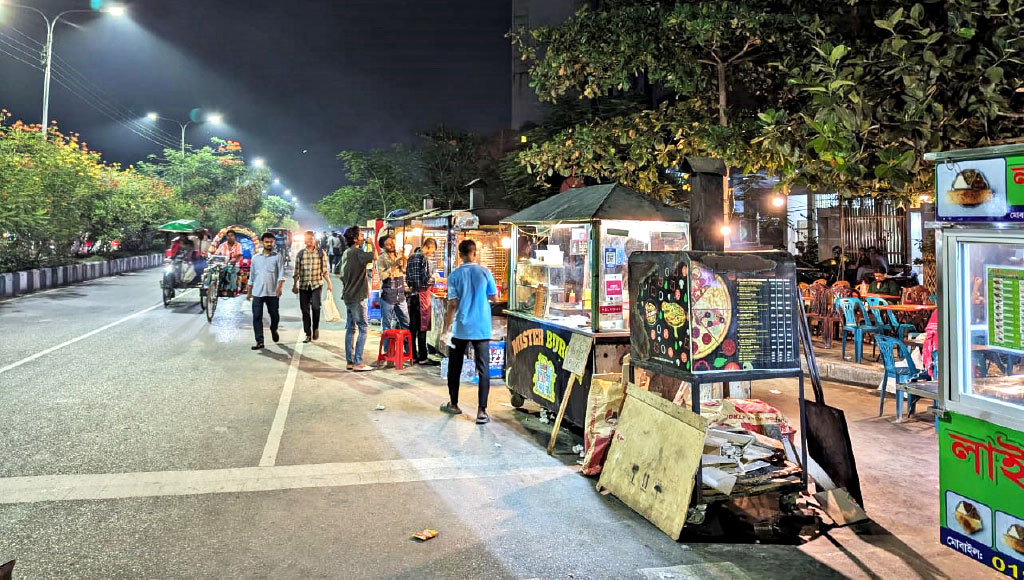
Indeed, despite their popularity and contribution to the local economy, many of these vendors operate in a legal grey area.
Their businesses bring vibrancy and commerce to the neighbourhood, yet without formal recognition or regulation, their futures remain uncertain.
Rony, a recent graduate, runs a pizza cart near the ICT Tower. Occasionally, some of his friends lend a hand.
He entered the Agargaon food scene without any formal culinary training.
‘I watched online videos, experimented at home, and gradually learnt how to make pizza,’ he said.
His cart now receives an enthusiastic response from food lovers, with daily earnings ranging from Tk 3,000 to Tk 4,000.
‘I started this journey out of a passion to do something unique. Even though I’m still trying to get a job, I’ll continue running my cart after securing one,’ he added.
The area also hosts a variety of other stalls, including tea vendors, fruit sellers, a plant nursery, and general merchandise stands.
On weekends, when the roads are free from regular traffic, the neighbourhood takes on a festive air, with a local fair drawing in crowds.
In addition to food stalls, vendors sell balloons, toys, books, artwork, kitchen utensils, decorative items, and more — creating a vibrant open-air market atmosphere in the heart of the administrative district.
The enthusiasm of local consumers is clearly evident across the area.
Shoriful Islam, a job seeker from Kallyanpur, is a regular visitor, often accompanied by his family, especially on weekends.
‘I come here with my family in the afternoon,’ he said. ‘After a walk along the wide roads, we sit at one of the food stalls for evening snacks, and sometimes even stay for dinner.’
Shakhawat Hossain, a private sector employee from Mirpur-11, also frequents the area.
‘I usually come here via the metro from my home. Although I’m currently employed, I also dream of becoming an entrepreneur. The motivation and courage of these young entrepreneurs truly inspire me. Besides enjoying the food, I find great joy in simply watching them work,’ he added.
The vibrant street food and vendor scene in Agargaon offers a compelling example of grassroots entrepreneurship in action.
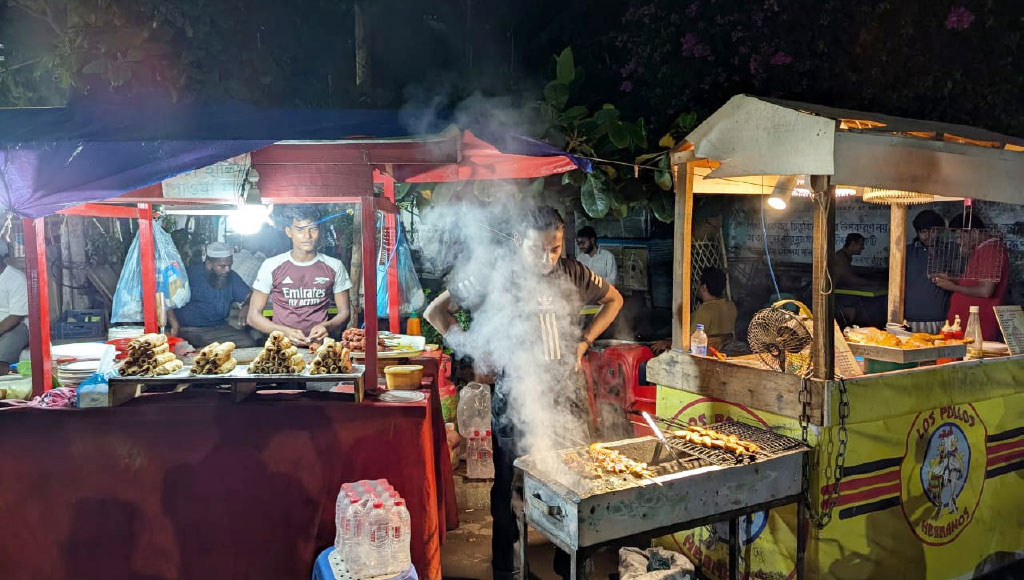
With minimal startup capital and basic infrastructure—often no more than a wooden cart or modified van—these young business owners, supported by family or friends, are generating thousands of takas in daily revenue.
When considered collectively, the estimated 300 carts in the area tell a larger story.
In a country where youth unemployment and underemployment remain pressing issues, particularly among university graduates, these micro-enterprises offer a powerful alternative.
They provide a low-barrier entry into entrepreneurship, foster innovation, and breathe life into what was once a largely bureaucratic and inactive urban zone.
Speaking recently at an event at Peking University, Nobel Laureate Professor Muhammad Yunus remarked that universities should focus on preparing young people to become successful entrepreneurs rather than mere job seekers.
‘I continue to promote the idea that all human beings are born to be entrepreneurs, not job seekers,’ he said, arguing that employment, in its traditional sense, is a flawed concept rooted in the legacy of servitude.
He encouraged students to think boldly and to aspire to change the world.
‘A job forces you to do what your supervisor wants. But human beings are not born to follow—they are born to create,’ he added.
He said an educational institution should not merely be a place to learn what had happened, but a space to imagine what could be.


