

Angular JS: Use an Angular Websocket Client with a Java Websocket Endpoint
In this tip you can see how to use the Angular Websocket module for connecting client applications to servers.
By

 CORE
·
·
Tutorial
CORE
·
·
Tutorial
CORE
·
Likes
(7)
Likes
There are no likes...yet! 👀
Be the first to like this post!
It looks like you're not logged in.
Sign in to see who liked this post!
Comment
Save
40.4K Views
Join the DZone community and get the full member experience.
Join For FreeIn this tip you can see how to use the Angular Websocket module for connecting client applications to servers. For this case, we have a Java endpoint, as below:
package com.mycompany.angularws;

import java.util.Collections;
import java.util.HashSet;
import java.util.Set;
import java.util.logging.Logger;
import javax.websocket.OnClose;
import javax.websocket.OnMessage;
import javax.websocket.OnOpen;
import javax.websocket.Session;
import javax.websocket.server.ServerEndpoint;

@ServerEndpoint("/atpendpoint")
public class ATPWSEndpoint {

    private static final Logger LOG = Logger.getLogger(ATPWSEndpoint.class.getName());
    private static Set<Session> peers = Collections.synchronizedSet(new HashSet<Session>());

    @OnMessage
    public String onMessage(String message) {
        if (message != null) {
            if (message.equals("HELLO SERVER")) {
                return "{\"hello\": \"Hello, if you need the ATP list just press the button ...\"}";
            } else if (message.equals("ATP SERVER")) {
                return "[{\"name\": \"Nadal, Rafael (ESP)\", \"email\": \"[email protected]\", \"rank\": \"1\"},"
                        + "{\"name\": \"Djokovic, Novak (SRB)\", \"email\": \"[email protected]\", \"rank\": \"2\"},"
                        + "{\"name\": \"Federer, Roger (SUI)\", \"email\": \"[email protected]\", \"rank\": \"3\"},"
                        + "{\"name\": \"Wawrinka, Stan (SUI)\", \"email\": \"[email protected]\", \"rank\": \"4\"},"
                        + "{\"name\": \"Ferrer, David (ESP)\", \"email\": \"[email protected]\", \"rank\": \"5\"}]";
            }
        }
        return "";
    }

    @OnOpen
    public void onOpen(Session peer) {
        LOG.info("Connection opened ...");
        peers.add(peer);
    }

    @OnClose
    public void onClose(Session peer) {
        LOG.info("Connection closed ...");
        peers.remove(peer);
    }
}
And, we access this endpoint like this:
- the client sends a hello message (HELLO SERVER), and the server answers with a simple text (Hello, if you need the ATP list just press the button ...).
- the client send another message, (ATP SERVER), and the server answers with a JSON object containing a list of tennis players
- the client will display this list in a table
<!DOCTYPE html>
<html>
    <head>
        <link rel="stylesheet" type="text/css"
                 href="https://ajax.googleapis.com/ajax/libs/angularjs/1.3.8/angular-csp.css">
        <title>Angular JS Web-Socket</title>
        <meta http-equiv="Content-Type" content="text/html; charset=UTF-8">
    </head>
    <body ng-app="ATP_PLAYERS" class="ng-cloak">
        <script src="http://ajax.googleapis.com/ajax/libs/angularjs/1.3.8/angular.min.js"></script>
        <script src="resources/js/angular-websocket.js"></script>

        <div ng-controller="atpController">

            <div id="helloId"></div>

            <form ng-submit="submit()">
                <button id="btnAtpId" type="submit" disabled>Send Message</button>
            </form>

            <table>
                <thead>
                    <tr>
                        <th>Rank</th>
                        <th>Name</th>
                        <th>E-mail</th>
                    </tr>
                </thead>
                <tbody>
                    <tr ng-repeat="item in ATP.atp">
                        <td>{{item.rank}}</td>
                        <td>{{item.name}}</td>
                        <td>{{item.email}}</td>
                    </tr>
                </tbody>
            </table>
        </div>

        <script language="javascript" type="text/javascript">
            angular.module('ATP_PLAYERS', ['ngWebSocket'])
                    .factory('ATP', function ($websocket) {
                        // Open a WebSocket connection
                        var ws = $websocket("ws://" + document.location.host +
                              document.location.pathname + "atpendpoint");
                        var atp = [];

                        ws.onMessage(function (event) {
                            console.log('message: ', event.data);
                            var response;
                            try {
                                response = angular.fromJson(event.data);
                            } catch (e) {
                                document.getElementById("helloId").innerHTML =
                                                                                   "Sorry, connection failed ...";
                                document.getElementById("btnAtpId").disabled = false;
                                console.log('error: ', e);
                                response = {'error': e};
                            }

                            if (response.hello) {
                                document.getElementById("helloId").innerHTML = response.hello;
                                document.getElementById("btnAtpId").disabled = false;
                            } else {
                                for (var i = 0; i < response.length; i++) {
                                    atp.push({
                                        rank: response[i].rank,
                                        name: response[i].name,
                                        email: response[i].email
                                    });
                                }
                            }
                        });
                        ws.onError(function (event) {
                            console.log('connection Error', event);
                        });
                        ws.onClose(function (event) {
                            console.log('connection closed', event);
                        });
                        ws.onOpen(function () {
                            console.log('connection open');
                            ws.send('HELLO SERVER');
                        });

                        return {
                            atp: atp,
                            status: function () {
                                return ws.readyState;
                            },
                            send: function (message) {
                                if (angular.isString(message)) {
                                    ws.send(message);
                                }
                                else if (angular.isObject(message)) {
                                    ws.send(JSON.stringify(message));
                                }
                            }
                        };
                    })
                    .controller('atpController', function ($scope, ATP) {
                        $scope.ATP = ATP;

                        $scope.submit = function () {
                            ATP.send("ATP SERVER");
                        };
                    });
        </script>
    </body>
</html>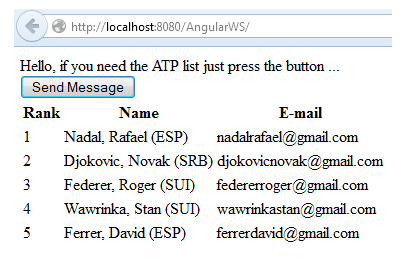
AngularJS
WebSocket
Java (programming language)
Published at DZone with permission of Anghel Leonard. See the original article here.
Opinions expressed by DZone contributors are their own.
Comments