


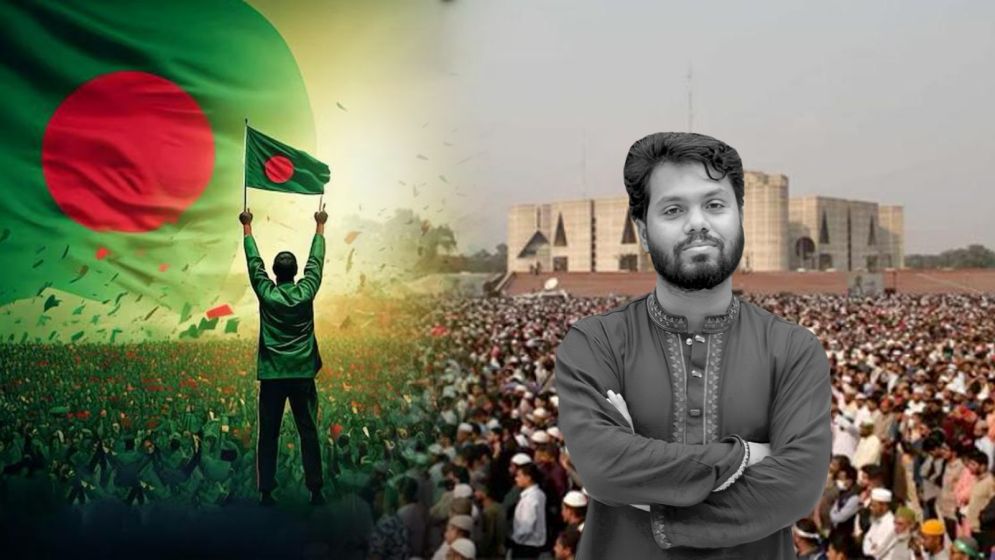
After the killing of Sharif Osman bin Hadi and the funeral that drew hundreds of thousands into the heart of Dhaka, the nation briefly convulsed with grief. Then, as it almost always does, the emotion receded. Death is the one certainty, and even martyrdom has a shelf life in public memory. Ordinary people, burdened by survival, do not grieve indefinitely. Mourning fades and life intrudes.
Bangladesh has seen this before. Take Abu Sayeed, the first martyr of the July uprising of 2024. The image of him standing with outstretched arms, absorbing police [rubber] bullets as if to arrest history itself, has already entered the country’s visual canon. It is painted on walls, reproduced in murals, stylized in art, and embalmed in textbooks. Sayeed’s image is immortal. His grief is not.
Today, the sorrow surrounding his death likely lives on only within his family and a small circle of intimates. For everyone else, it has been crowded out by the daily grind—by inflation, insecurity, and the numbing demands of survival in a harshly transactional world that steadily drains people of the luxury of sustained emotion.
There is also a harsher truth. Abu Sayeed’s death, in every grimly practical sense, achieved closure. Say this plainly, even if it sounds brutal—his martyrdom worked. It ignited the first spark of a mass uprising that eventually toppled Sheikh Hasina’s dictatorial regime, which had ruled for more than a decade and a half through force, and the systematic stripping of political and human agency. Sayeed’s sacrifice served a utilitarian purpose. History moved. His chapter, however tragic, is complete.
Hadi’s death is not.
His martyrdom remains unfinished, unresolved—and that is precisely why the public response has been so fervent, so emotionally unspent. The honor conferred upon him, the intensity of the mourning, and the almost unprocessed grief point to something deeper than the catalytic role of yet another fallen hero. To understand it, one must first understand what might now be called the “Hadi effect.”
Hadi entered public consciousness through social media clips and television talk shows, in which he was in viral confrontations with some known social and political stalwarts. He was physically unassuming: short with disheveled hair and beard but sharp-eyed. His power lay in language. He spoke in an unapologetically plebeian Bangla, tinged with the rural cadences of southern Bangladesh, far removed from the polished, praetorian diction of Dhaka’s urban elite. It was a voice that sounded familiar, even intimate, to millions.
-697385ef5f416.jpg)
With
a modest madrasa education, time at Dhaka University, and roots in a
lower-middle-class family, Hadi embodied a volatile combination: the subaltern
with just enough access to threaten established hierarchies. He was neither
fully inside the system nor wholly outside it. His religiosity—unapologetic and
deeply Islamic—resonated powerfully in a country where roughly 90 percent of
the population is Muslim and where faith remains one of the few enduring
sources of collective identity.
After the 2024 uprising, Hadi began to attract sustained attention from mainstream media. As remnants of the Awami League’s cultural and political establishment cautiously tested the waters for a comeback, he confronted them head-on. His language was blunt, often abrasive, and deliberately so. Again and again, Hadi warned of the danger of allowing the party back into public life through its cultural and social networks, long before it could reenter formal politics.
This was, in all good senses, not a conventional political battle. Hadi’s fight—if it can be called that—was aimed squarely at culture. For decades, the Awami League had exercised near-hegemonic control over Bangladesh’s cultural sphere, saturating media, academia, and the arts with its preferred narratives. In principle, this was unsurprising. As a center-left party that led the 1971 liberation war, the Awami League rooted its legitimacy in language, identity, culture, and a particular vision of Bengali nationalism. Much of the country’s intellectual class found that vision both familiar and institutionally rewarding.
But under Sheikh Hasina’s four consecutive terms—three of them secured through elections widely regarded as absolutely rigged or non-participatory—that cultural project metastasized. What had once been advocacy hardened into dogma. Bengali nationalism was narrowed, history was revised, and the liberation war was increasingly reframed to elevate Sheikh Mujibur Rahman into a near-mythic figure. Cultural production ceased to be pluralistic. It became devotional.
All the while, Bangladesh’s neighboring “big brother,” India, offered unapologetic backing to Hasina’s growing dictatorial rule—through New Delhi’s iron-fisted political patronage and Kolkata’s avuncular cultural endorsement, rooted in a largely Hindu-dominated intellectual sphere. West Bengal’s cultural industry, it bears recalling, enjoyed a historical head start during the British era, having occupied the colonial mainstream by adopting English and its bureaucratic pathways far earlier than Muslim-majority East Bengal, today’s Bangladesh.
The result was predictable. Bangladesh’s mainstream media and cultural elites, enamored of Kolkata’s paternalistic validation and New Delhi’s political overtures, moved beyond amplification to enforcement of this convoluted narrative. In doing so, they marginalized the worldview of a broad majority of Bangladeshis—religiously moderate Muslims who could no longer recognize themselves in an imposed version of “secular” nationalism. Over time, reverence for Sheikh Mujibur Rahman slid from respect into ritual, leaving little space for dissent without social or professional cost.
That resentment did not disappear. It waited.
-6973860caf892.jpg)
After
the 2024 uprising, it erupted—most visibly in the demolition of Mujib’s statues
and murals across the country. It is a mistake to portray these acts as
vandalism or iconoclasm; they were an attempt, however raw, to reclaim cultural
agency from a state-sanctioned orthodoxy. At their core was a demand to
reassert a socio-political identity grounded in religious moderation rather
than enforced secular symbolism.
No figure came to embody that rupture more clearly than Sharif Osman Hadi.
Hadi’s rise in the collective consciousness followed a clear arc. Without apparent calculation, he first emerged on social media and then broke into mainstream platforms, methodically exposing the hypocrisy of a media-intellectual complex that had enabled Hasina’s authoritarianism while cloaking itself in moral superiority and with big neighbour’s two-front backing. His refusal to temper his critique—his insistence on naming collaborators rather than abstractions—struck a nerve.
For many Bangladeshis in the immediate aftermath of July 2024, Hadi sounded like the voice they aspired to hear. He said aloud what others had whispered, or suppressed entirely. He appeared sincere—perhaps even recklessly so. And in a political culture exhausted by doublespeak, that honesty proved magnetic.
Hadi did not stop at critique. With public funding, he went on to establish the Inqilab Cultural Center—an explicit attempt to build an alternative cultural infrastructure. Its mission was clear: to promote a Bangladesh-rooted cultural idiom grounded in Islamic values, one that resonated with the social instincts of the majority rather than the narrow, urban, secular aesthetic long amplified by elite institutions. For many Bangladeshis who had viewed the dominant version of Bengali cultural expression as exclusionary or imposed, Inqilab Center felt less like a provocation than a correction.
Yet post-uprising Bangladesh was not a laboratory for cultural experimentation alone. Under an interim government, the country lurched from economic anxiety to political uncertainty, and the public mood increasingly gravitated toward one demand: stability through elections. Hadi grasped this quickly. Cultural resistance, he concluded, would remain vulnerable unless it was anchored in formal political power. Probably Parliament, not panels or platforms, was where lasting leverage lay.
His decision to contest a seat in the heart of Dhaka elevated him almost overnight. Running without the backing of any major political machine, Hadi positioned himself against a seasoned, well-financed candidate from a party widely expected to return to power. The asymmetry was stark. It was a David-and-Goliath contest in a city—and a country—hungry for rupture. Attention was inevitable.
-6973862d633b8.jpg)
What
followed was not a media strategy so much as a studied refusal to have one.
Hadi allowed the symbolism of the contest to grow organically. His campaign was
conspicuously bare-boned: leaflets instead of billboards, handshakes instead of
motorcades. He prayed Fajr with voters, walked through working-class
neighborhoods, and spoke in the same unpolished vernacular that had first made
him recognizable. Social media did the rest, amplifying what appeared
unscripted and therefore credible.
At the core of Hadi’s appeal was a single conviction he managed to implant with surprising speed: that he was incorruptible. After sixteen years of Sheikh Hasina’s rule—sustained by alliances with crony capitalists, a compliant bureaucracy, and selective patronage—corruption had become the regime’s defining signature. Hadi offered himself as its antithesis. He did not promise technocratic reform or institutional overhauls. He promised something simpler and, for many, more persuasive: that he would be brave enough to confront power without flinching.
In the early days after the July uprising, that same faith had briefly been invested in student leaders who had ignited the 21-day mass movement against systemic discrimination. They, too, were seen as untainted and fearless. But that confidence eroded quickly as politics reasserted its old habits. Almost by default, the burden of preserving that belief—of proving that integrity could survive proximity to power—shifted to Hadi.
Interestingly, by no measures, he had been the architect of the July uprising. Yet in its aftermath, he became one of its most consequential inheritors. The Hadi of television debates occupied the mind but the Hadi of the campaign trail reached somewhere deeper. He crossed the rare threshold from recognition to attachment, from argument to belief. That distinction matters. It explains why his killing produced a palpable sense of loss—why so many ordinary Bangladeshis felt, without irony, that something essential had been taken from them. For a moment, it seemed as if the last plausible vessel for change had been emptied.
Martyrdom, however, is not merely another ending. In death, Hadi has grown larger—but whether he has grown stronger remains unresolved. History offers no guarantees. His killing has already created opportunities for others to speak in his name, to trade on his image, to convert sacrifice into political currency. Martyrdom has always been an easily appropriated asset.
Still, it would be a mistake to assume that fading grief will render Hadi irrelevant in time. Public emotion inevitably ebbs but the unfinished struggles do not. The idea he carried—the insistence on reclaiming cultural agency, on confronting corruption without accommodation, on refusing elite permission—has not been settled, let alone defeated.
Hadi’s project remains incomplete. That is the real source of his persistence in the national imagination. And anyone who believes otherwise misunderstands both the moment and the man.
—
Faisal Mahmud is the Minister (Press) of Bangladesh High Commission in New Delhi
This article was originally published in Al Jazeera. It is republished here with slight modifications.