

A conversation with Tarique Rahman in a time of reckoning…

Rezaul Karim Rony
Publish: 07 Jan 2026, 08:57 PM
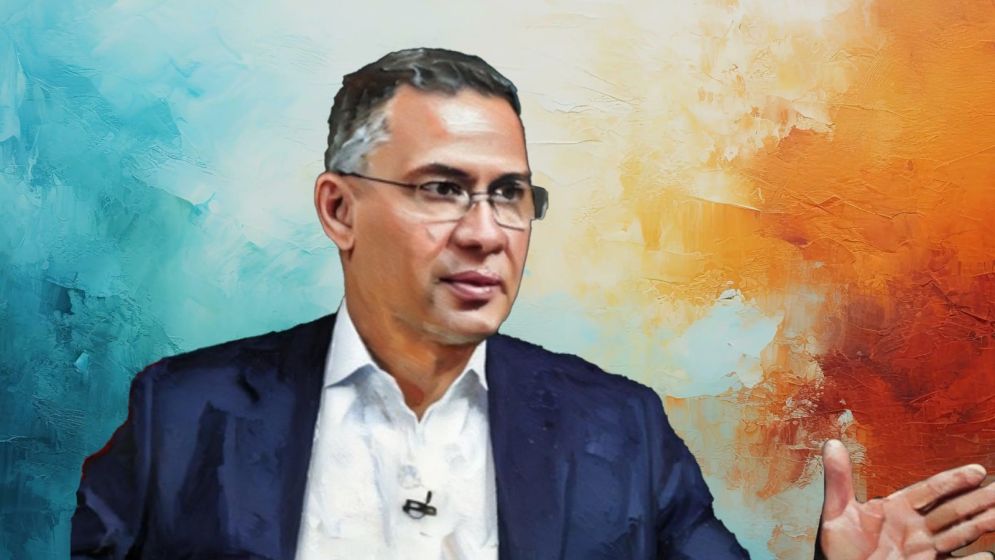
I met Tarique Rahman face-to-face for the first time in nearly 22 years.
When he saw me, recognition came instantly. “Rony,” he said, smiling. “I’ve wanted to meet you in person for a long time. I’m glad I finally met you.”
It was an unguarded moment, the kind that rarely survives proximity to power.
At the door, shoes were piled in a small disorderly heap. Everyone had removed theirs, including the aide who escorted me in. I followed suit.
Tarique stopped me. “Please,” he said, “put your shoes back on. I insist.” It was a small gesture, but an intentional one. Probably less about etiquette than hierarchy, perhaps, or dignity.
We sat down, and without preliminaries he asked the question that framed everything that followed. “What can we do for Bangladesh?”
The meeting was supposed to last 10 or 15 minutes. It began at 1:30 p.m. on January 6, 2026. When I finally stood to leave, it was nearly 3 pm.
Outside, a crowd waited. His schedule was packed. But he gave me time and we talked.
Face-to-face encounters strip away the illusions that distance allows. This was not a rehearsed performance. It was an extended, informal conversation.
What struck me most was [his] pain—barely concealed behind a practiced smile. He listened carefully as I spoke at length about what I dislike about his party and its political culture.
He did not deflect. He agreed with much of it. He spoke of correction, of restraint, and of the need for public cooperation.
The conversation wandered, and so will this reflection. That, too, felt revealing.
Like many Bangladeshis, I wanted to understand not what Tarique Rahman says he wants, but what he is actually trying to do.
I will avoid personal details and focus instead on the political arguments he chose to make.

“Restoring peace is the first priority,” he said. “After the fifth [August], we could have taken revenge. We could have let people take the law into their own hands. I could have taken revenge on those who beat me, who pushed us into unspeakable oppression. But we didn’t. I stopped it.”
His point was blunt. Retaliation would have destroyed the fragile opening the country now has. “If we hadn’t restrained ourselves,” he said, “Bangladesh would already be sliding into long-term conflict.”
I reminded him of something I had said publicly before. “Give us the [election] schedule, and Tarique Rahman will return,” I said in a number of TV talk shows.
Within 18 hours [of election schedule declaration], he had announced his return plan.
I told him—plainly—that his decision not to return at that moment [right after August 5th] was the right one. An immediate return, I argued, would have created a parallel center of power in a country that struggles with institutional discipline.
Bangladesh, as it is, does not manage dual authorities well.
Today, the interim government is performing routine functions. The Election Commission is formally in charge. And yet, public suspicion remains.
That the administration is quietly leaning toward the BNP.
Tarique brushed aside the insinuation. Everyone, he said, knows who actually controls the bureaucracy…and who does not.
That, perhaps, is the unresolved tension at the heart of Bangladesh’s transition. Restraint mistaken for weakness and distance read as manipulation.
And a political actor who insists he is holding back not because he must—but because he believes the country cannot afford what would happen if he did not.
He agreed with my assessment. His return, he said, had been hurried and imperfect, driven more by urgency than preparation.
“I wanted to come back as quickly as possible,” he told me. “[Some] People say I’m unpopular. But I can’t even travel for half an hour without it turning into five because of the crowds.”
What he described probably was not triumphalism, but attentiveness. Much of his support, he observed, now comes from the young.
He notices them standing along the roads, watching, waiting.
“There’s a certain expectation in their eyes,” he said. Years in politics, he believes, have taught him how to read that look.
He spoke of himself as a simple man, and of a younger generation that works in similarly simple, almost instinctive ways. With them, he suggested, rebuilding the country feels less abstract…more achievable.
If power had been the objective, he insisted, it could have been seized immediately after the 5th August.
But that, he argued, was never the point.
“Our struggle is about restoring the people’s right to vote,” he said. “The administration is not my goal. The people are.”
He rejected the idea that the state should belong to the BNP…or to any party. It should belong, he said, to citizens themselves. In his telling, such propaganda reveals contempt for ordinary people, not anxiety about him.
I raised a harder question.
Across the country, I said, I had met persecuted leaders and activists—parents who had lost children, spouses who had lost partners, families whose most productive years were consumed by struggle. Many were not even from his party.
How, I asked, could such sacrifices ever be repaid?
His response came quickly. “Did they suffer for me? For the party?” he asked. “Or for the country?” He drew a clear distinction between political ambition and personal risk.
Those who gave their lives, he said, crossed that line. They are not beneficiaries; they are heroes. And heroes cannot be honored with titles or party posts.
To try, he argued, would diminish the meaning of what they endured.
For 17 years, he said, his party has lived inside sacrifice—choosing endurance over comfort. Struggle over reward. No one, he insisted, sustains that level of loss for personal gain alone.
The challenge now is not compensation, but purpose: to rebuild a country in a way that gives meaning to what was lost, and dignity to those who paid the price, he said.
He widened the lens further. Many, he noted, had aligned themselves with the Awami League and became beneficiaries of power. Those who resisted paid a different price—one that carries no tangible reward.
That, he said, is precisely why the burden now lies with political leaders to rebuild the country in a way that preserves the dignity of those who were killed or maimed.
His mother, Begum Khaleda Zia, he added, has long made the same point.
Much has been said about the July mass uprising, he continued, but its meaning will be hollow unless it produces something enduring.
Civil rights that are respected and a government that can be held to account. And of course a political culture that recognizes human dignity.
This, he stressed, is not a partisan obligation.
Ordinary citizens bore the brunt of the upheaval, often without any political affiliation. Politicians, he said, forget this at their peril. Change does not originate in party offices; it flows from the public itself.
National credibility, in his view, begins at home. No country—India, the United States, China, or those in Europe—will take Bangladesh seriously unless it can demonstrate internal cohesion and shared prosperity.
External respect, he argued, is a byproduct of domestic legitimacy.
When I pressed him on how such change could be delivered, his answer was deliberately expansive. Responsibility, he said, cannot rest on one leader or one party.
Citizens like me must step forward. So must activists and leaders from other political traditions.
He described meetings with professionals, technocrats, and figures across the ideological spectrum—an attempt, he said, to shift politics away from slogans and toward execution.
He invoked his father, President Ziaur Rahman, whose brief tenure coincided with a period of political ferment. What distinguished that era, he argued, was not the language of revolution but its translation into programs.
Today, he said, the BNP has its own policy frameworks aimed at reaching the most marginalized. Progress will be incremental, not immediate. But transparency, honesty, and public participation, he believes, can gradually restore stability.
The most urgent test, in his telling, lies with the country’s youth. Without employment, recreation, and avenues for self-expression, restlessness curdles into disorder. Ignoring that reality, he warned, would invite anarchy rather than renewal.
I raised a concern that has been quietly circulating. That is the BNP is suddenly fashionable again. Poets and intellectuals who once praised the Awami League now offer public devotion to its arch rival.
To me, it felt less like conviction than opportunism—and a troubling signal.
He did not disagree.

The BNP, he said, is not a rigidly ideological organization but one grounded in values and principles. That, he argued, is precisely why it endured its most difficult years.
Membership, in his view, should rest on integrity and competence instead of on flattery or convenience. Praise, he said, is cheap.
What the party needs instead is engagement, and from observers like me, something even more valuable: sustained, constructive criticism.
I raised a note of caution. In Bangladesh, I said, the language of free criticism often slides into something darker—a sustained campaign of character assassination. We have seen how easily that tactic was weaponized under the previous regime.
He waved the concern aside, not dismissively but with the weary confidence of someone long accustomed to it.
Let it happen, he said. The question is not whether accusations circulate, but whether people believe them. For seventeen years, he reminded me, attacks against him were relentless. Yet, he argued, public intuition has a way of separating noise from truth.
His responsibility, as he sees it, is simply to keep acting with consistency. Much of the vitriol, he noted, lives online. People may be confused for a time, but clarity eventually returns.
A system built on accountability, he believes, naturally shrinks the space for propaganda.
I shifted the conversation to a deeper cultural concern. Bangladesh’s extreme political polarization, combined with the small-mindedness of its literary and intellectual circles, has stunted the emergence of serious thinkers.
Instead of cultivating independent writers and ideas, the system manufactures loyalists—party functionaries disguised as intellectuals. A democratic state, I argued, should do the opposite.
I thanked him, pointedly, for something rare: despite my public and often unsparing criticism of his party, I am still occasionally invited to BNP forums.
He smiled, acknowledging the contradiction. For most of the past fifteen years, he said, the BNP was fighting simply to exist. There was little room for intellectual growth or cultural confidence.

The criticisms I raised, he admitted, are not unfounded. But the party never had the space to address them. Now, he said, that reckoning can no longer be postponed.
Political parties, after all, are not merely electoral machines; they are meant to be engines of nation-building. The gaps must be filled—gradually, but deliberately.
That effort, he stressed, requires stability above all else. Creativity cannot flourish in a permanent crisis. A functioning democracy, peace, and respect for merit would make it entirely plausible, he argued, to produce a new generation of writers and thinkers who can represent Bangladesh to the world.
The tools already exist. Technology has collapsed distances; one can now write for global audiences from Dhaka itself. He noted, with some generosity, that I already do this.
But he did not deny the larger failure. Bangladesh lacks voices of international stature, and that absence weakens its global standing. Building bridges with foreign writers and journalists—and even facilitating training abroad, if necessary—should be part of correcting that deficit.
I pressed one final point.
The old political culture—where one party exists primarily to destroy another, where competition degenerates into vendetta—must not be allowed to return. Bangladesh needs to move toward a genuinely multipartisan political order.
I urged him to see his role as a potential symbol of national cohesion. His legacy, I suggested, could be measured by whether other political voices find space, security, and legitimacy alongside his own.
In today’s Bangladesh, that may be the hardest task of all—and the most necessary one.
As our conversation drew to a close, I returned to what felt like the underlying crisis beneath all others. Bangladesh’s political order, I said, has not merely weakened—it has fractured.
Years of personalized rule and informal power networks have hollowed out institutions, corroded public morality, and frayed the social fabric itself. Unless that deterioration is confronted directly, instability will reproduce itself in cycles.
Any serious effort to rebuild the country, I argued, must begin with repairing political culture. And that responsibility cannot be outsourced.
It must be led—visibly and deliberately—by the BNP and by him.
I had brought a book with me: Political Order and Political Decay by Francis Fukuyama. When I handed it over, he accepted it with quiet courtesy.
Inside, I had written a brief inscription–”Warm wishes to a leader who might yet halt Bangladesh’s political decay and help restore a durable political order.”
Whether that hope proves justified remains an open question. But as I left, I allowed myself a cautious optimism—that this exchange, and the choices that follow it, could mark the beginning of a different political trajectory.
One in which leadership is measured by its capacity to rebuild trust, restore institutions, and serve the people whose patience has already been stretched to the limit.
—
Rezaul Karim Rony is a writer and thinker. He is the editor of Joban magazine
(Translated from Bangla by Faisal Mahmud)