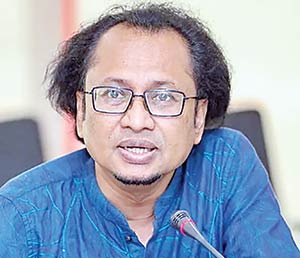
Prime Minister’s Infor-mation and Broadcasting Adviser Zahed Ur Rahman on Tuesday described the 2-hour delay he faced at New Delhi’s Indira Gandhi International Airport as harassment and said his decision to return to Bangladesh was an “immediate protest” by the government.
Speaking at a regular press briefing at the Secretariat PID conference room, he said the incident should not affect future Bangladesh-India engagement, while also highlighting the government’s latest initiatives in healthcare, education, infrastructure, social welfare and border management.
Zahed Ur Rehman said he did not travel to India as a private individual. He said he went there as a representative of the Bangladesh government and the state.
“I did not go there as an individual. I went as a representative of this government and the state. What happened to me there made me feel that an immediate protest was necessary. That is why I decided to return,” he said.
According to the advisor, Indian immigration authorities kept him waiting for about two to two and a half hours after he arrived at Delhi airport. Initially, he was not allowed to enter India.
He said that although Indian authorities later granted him permission to enter following high-level intervention, he declined the offer and returned to Dhaka.
“At one stage, they tried very hard to get me to enter India and participate in my scheduled programme. But I did not do that because I felt there should be a clear response from the government as a state,” he said.
Zahed Ur Rehman said his decision was not intended to create any negative situation between the two countries.
Rather, he wanted to send a message at home and abroad that the current government has a mandate from the people and will not compromise on national dignity.
Despite the incident, he expressed hope that it would not negatively affect future relations or engagement between Bangladesh and India.
When asked whether he would visit India again if invited, he replied, “I will definitely go. I want a rational and practical relationship with India. However, no relationship can be built by sacrificing Bangladesh’s interests and dignity. Bangladesh first we will move forward with this policy.”
He added, “Friends can be changed, but neighbours cannot be changed, this is true for both Bangladesh and Inida. Therefore, Bangladesh wants to advance relations with neighbouring countries on the basis of mutual respect and equality.”
“We have come down from where we were. In the meantime, the relationship has reached a very bad stage. Putting those aside, we want to engage, do business and trade. There can be various types of exchanges between us,” he said.
Referring to the issue of people being pushed across the border, the adviser said his previous comments had often been misunderstood.
“I still think and my explanation was then that there is a political reality in West Bengal. They have also brought this issue in their election manifesto. These steps may have been part of that,” he said.
He added that some people point out that the Border Security Force (BSF) is under India’s central government and therefore raise questions about the role of New Delhi.
In response, he said the BSF often has to implement decisions linked to state-level policies. However, he repeated that he does not believe the actions were intended to put pressure on Bangladesh.
“I said then and I say now�"pressure will be created, that is not the case,” he said.
The adviser also discussed the incident that took place during his recent visit to India. He said media reports in both Bangladesh and India had broadly reflected what happened.
“I did not go there as an individual. I went as a representative of the government, as a representative of the state. As a result, I feel that we need to protest immediately about what happened to me there,” he said.
He stressed that his response to the incident was immediate and was not intended to damage relations between the two countries.
“What I did for the treatment I received is an immediate reaction to that treatment. I personally want India to come with us with the mindset that they will work with a democratic government,” he said.
The adviser noted that India had previously expressed interest in working with a government that has a mandate from the people. He said he hopes that commitment will continue.
“I hope they will move forward with that position. If I get an opportunity to play a role somewhere, if I get an invitation, I will definitely go to India. I repeat, the person Zahid did nothing there. I did not take the matter personally,” he said.
The adviser also highlighted several important issues that require discussion between the two countries.
He said the Ganges Water Sharing Agreement will expire in December this year, while discussions on the Teesta Agreement and other shared river issues remain important for Bangladesh.
“The Ganges Water Agreement is expiring in December this year. We have discussions about that water agreement. We have discussions about the Teesta Agreement. We have many other issues related to water. We have rights. Therefore, we have to engage with them,” he said.
He added that he is ready to play a constructive role in these matters if given the opportunity in the future.
He also rejected claims that the incident was linked to his not carrying a diplomatic passport.
“I did not take my diplomatic passport. But that was for another reason. My passport had a SAARC sticker. As a result, the facilitation was supposed to be done the way diplomatic passports work. So that is not a reason,” he said.
The adviser explained that a diplomatic passport is a privilege rather than a requirement.
“If I never take a diplomatic passport, will my foreign travel stop Being given a diplomatic passport is a privilege. I can take it or not. There is no such thing as I have to take it,” he said.
Zahed Ur Rehman travelled to Delhi on Sunday on an Air India flight from Dhaka as part of a pre-scheduled visit. He was received at the airport by Bangladesh High Commissioner Riaz Hamidullah.
After a lengthy wait at the immigration desk, Indian authorities informed Bangladeshi officials that Zahed Ur Rehman’s name appeared on a watchlist. Later, following intervention by India’s Ministry of External Affairs, he was cleared to enter the country. However, he chose to return to Bangladesh.
On Monday, a day after the incident, Bangladesh’s Ministry of Foreign Affairs summoned the acting representative of the Indian High Commission in Dhaka and expressed strong dissatisfaction over the matter.
Meanwhile, the government briefing also highlighted progress in several sectors.
Officials said ICU units have been opened in 10 district hospitals across the country. Special ventilator and oxygen facilities for children are also being expanded.
A pilot programme has been launched under which health workers will provide primary healthcare through door-to-door visits and refer patients to hospitals when necessary.
In the education sector, the government announced the launch of the “Startup, Science Project and Innovation Idea” programme. Teams of students and teachers from classes six to twelve will participate in innovation projects at upazila, district and national levels.
In the communications sector, Bangladesh and China have signed an agreement to build the Ninth Bangladesh-China Friendship Bridge. The 2.62-kilometre bridge over the Lohalia River in Patuakhali is expected to improve transportation and economic activity in the southern region.
The briefing also said that Border Guard Bangladesh (BGB) prevented 131 push-in attempts along the borders of Kushtia, Chuadanga, Satkhira, Panchagarh, Nilphamari, Lalmonirhat, Thakurgaon and Jamalpur.
At the same time, 90 infiltration attempts were foiled along the Myanmar border, while 21 Bangladeshi citizens were successfully brought back to the country.
The government also highlighted several other initiatives, including a plan to plant 250 million trees over the next five years, the celebration of “Nazrul Barsho,” the expansion of the Family Card programme, and an increase in rice distribution under the VGF programme from 10 kilograms to 15 kilograms.
Concluding the briefing, Zahed Ur Rehman reiterated the government’s position on foreign relations.
“We do not want conflict with any country. But our position on Bangladesh’s self-respect and national interests will always remain clear,” he said.





