
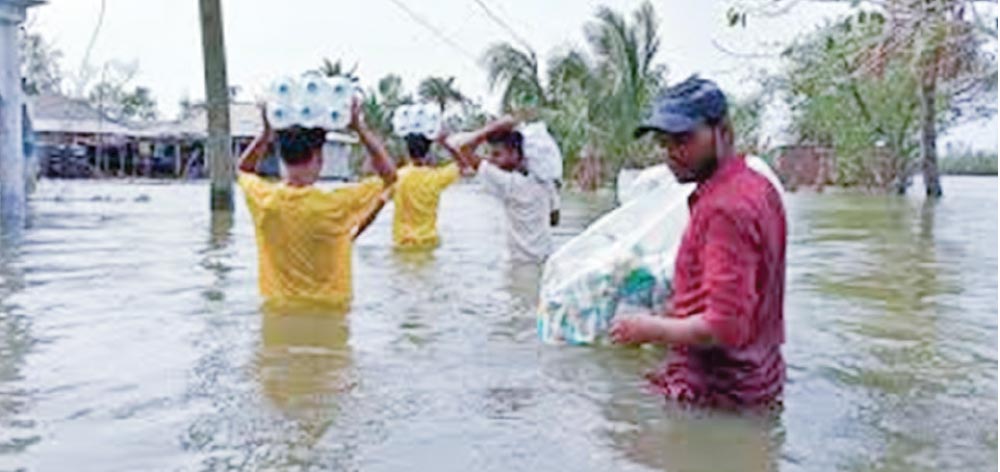
In Bangladesh, charity is impossible to ignore. Every year, during floods, winter crises, Ramadan, or national emergencies, the country witnesses an extraordinary wave of public generosity. Food packages are distributed, fundraising campaigns spread rapidly across social media and charitable organizations compete to provide relief to vulnerable communities. Photographs of smiling volunteers carrying aid boxes often dominate online platforms. Humanity, compassion and social responsibility are constantly celebrated in public discourse.
At first glance, this appears to be a deeply encouraging reality. It suggests a society rich in empathy and collective responsibility. Bangladesh has repeatedly proven that during moments of crisis, ordinary citizens are capable of remarkable solidarity and sacrifice. People donate money beyond their capacity, communities unite to support disaster victims and countless volunteers work tirelessly to help strangers. Yet beneath this visible culture of charity lies a troubling contradiction.
While public generosity has become increasingly common, private kindness often appears dangerously absent. This contradiction raises an uncomfortable but necessary question: if charity truly reflects moral character, why does that morality so often disappear when there are no cameras, no applause and no public recognition?
Modern society has transformed charity into something highly visible. Social media has played a major role in this transformation. Platforms reward attention, and acts of giving now receive likes, shares, praise, and admiration. Public charity itself is not wrong. In many cases, visibility can inspire others to contribute and create awareness about important social causes. Relief campaigns and online fundraising have saved lives and helped countless people. The problem begins when image becomes more important than integrity.
Too often, charity is treated as a performance rather than a principle. Many individuals appear deeply compassionate in public spaces while behaving very differently in private life. Someone may organize food distribution program while humiliating employees at work. Another person may post emotional messages about humanity and kindness while engaging in cruel personal attacks online. Some people speak passionately about morality, religion and social responsibility but fail to practice patience, empathy, or respect inside their own homes. This moral inconsistency has become so common that society rarely questions it anymore.
Real character is revealed not during public charity events, but during ordinary daily interactions. It appears in how people speak to workers, how they treat drivers, how they respond to disagreement, how they behave toward vulnerable individuals and how they act when nobody is watching. The phrase “charity begins at home” carries a meaning far deeper than financial generosity. Home is where morality should naturally begin. It is where patience, sacrifice, emotional responsibility and care are supposed to exist first. Yet many families today are struggling with precisely those values.
A society cannot genuinely claim to value humanity while neglecting humanity within the family itself. Public generosity loses credibility when private responsibility disappears. The contradiction extends into domestic life as well. In many homes across South Asia, domestic workers continue to face disrespect, impatience and emotional harshness. A small mistake may trigger humiliation, shouting, or insults. Ironically, such behavior sometimes comes from individuals otherwise recognized for their charitable work and religious devotion.
Society often celebrates visible acts of kindness while ignoring invisible acts of cruelty. Yet private cruelty eventually weakens public morality. A nation cannot build a compassionate culture if empathy exists only for audiences and cameras.
The challenge before modern society is therefore not simply increasing charity, but restoring sincerity within charity itself. Humanity must become a daily habit rather than an occasional event.
Morality must remain consistent across public and private life. Because ultimately, charity is not only about giving money away. It is also about refusing to take away another person’s dignity.
Perhaps that is the question society must confront honestly today: if kindness disappears inside homes, workplaces and private conversations, then what exactly are we presenting to the world under the name of charity? Perhaps the answer begins with something very simple; before trying to save humanity publicly, we must first learn how to treat the people closest to us with humanity privately.
The writer is an advocate, High Court





