
A Double Pointer (Pointer to Pointer) is a pointer that stores the address of another pointer. It provides an additional level of indirection for accessing data.
- The first pointer stores the address of a variable.
- The second pointer stores the address of the first pointer.

Declaring a Pointer to Pointer
A pointer to pointer is declared by placing an additional * before the pointer name. The first * represents a pointer, while the second * indicates that the pointer stores the address of another pointer.
Syntax
data_type **pointer_name = &pointer_variable;
Here,
- data_type specifies the type of data being pointed to.
- ** indicates a pointer to another pointer.
- pointer_name is the name of the double pointer.
- pointer_variable is an existing pointer whose address is stored.
Example: Declaring and Using a Double Pointer
#include <bits/stdc++.h>
using namespace std;

// Driver code
int main()
{
  int variable = 169;

  // Pointer to store the address
  // of variable
  int* pointer1;

  // double pointer to store the
  // address of pointer1
  int** pointer2;

  // Storing address of variable
  // in pointer1
  pointer1 = &variable;

  // Storing address of pointer1
  // in pointer2
  pointer2 = &pointer1;

  // Displaying the value of variable
  // with using both single and double
  // pointers.
  cout << "Value of variable :- " <<
           variable << "\n";
  cout << "Value of variable using single pointer :- " <<
           *pointer1 << "\n";
  cout << "Value of variable using double pointer :- " <<
           **pointer2 << "\n";
  return 0;
}
Output
Value of variable :- 169
Value of variable using single pointer :- 169
Value of variable using double pointer :- 169
Explanation: pointer1 stores the address of variable, while pointer2 stores the address of pointer1. Dereferencing pointer2 once gives pointer1, and dereferencing it a second time retrieves the value stored in variable.
Pointer to Pointer Representation
The following diagram illustrates the relationship between a variable, a pointer, and a pointer to pointer.
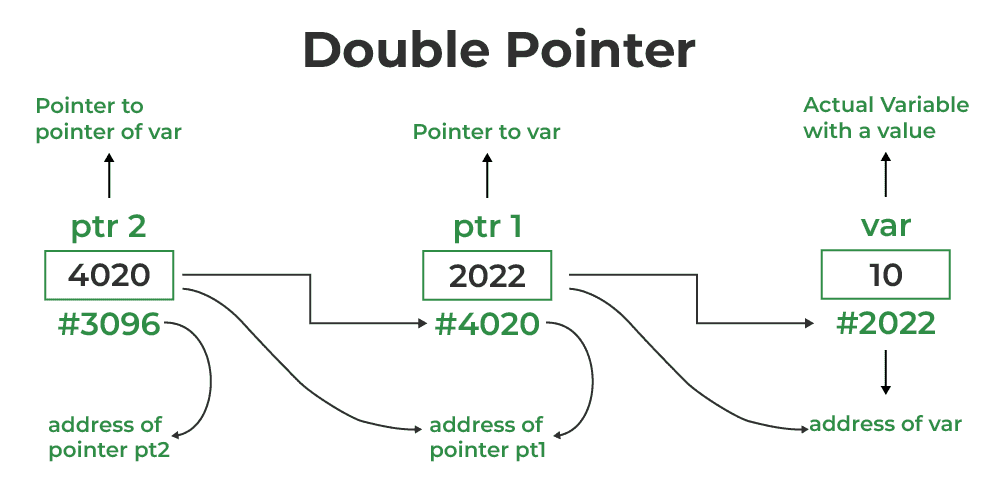
Working of a Double Pointer
A double pointer introduces two levels of indirection.
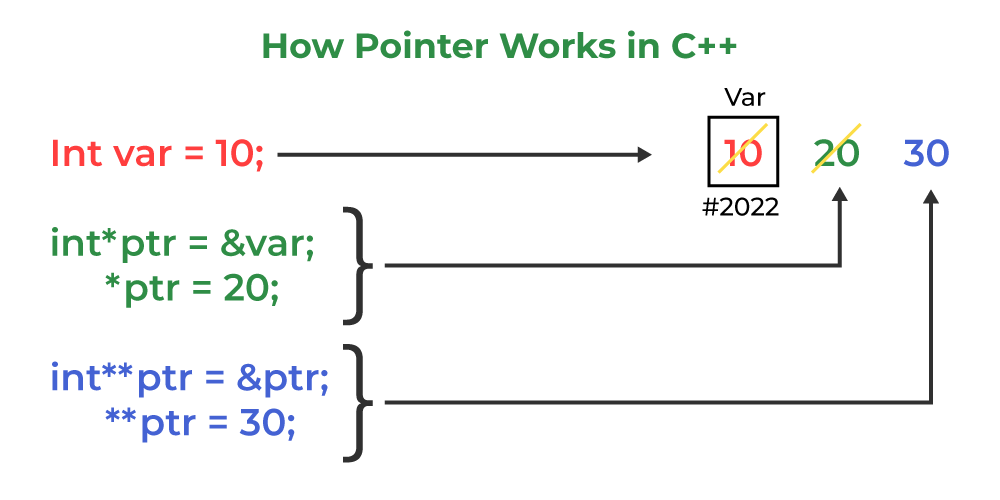
- pointer1 stores the address of the variable.
- pointer2 stores the address of pointer1.
- *pointer2 gives pointer1.
- **pointer2 gives the value stored in the original variable.
Size of a Double Pointer
A double pointer occupies the same amount of memory as a normal pointer because both store only memory addresses. The size depends on the system architecture rather than the pointer type.
- On most 64-bit systems, pointers occupy 8 bytes.
- On most 32-bit systems, pointers occupy 4 bytes.
#include <bits/stdc++.h>
using namespace std;

// Driver code
int main()
{
  int val = 169;
  int* ptr = &val;
  int** double_ptr = &ptr;

  cout << " Size of normal Pointer: " <<
            sizeof(ptr) << "\n";
  cout << " Size of double Pointer: " <<
            sizeof(double_ptr) << "\n";
  return 0;
}
Output
 Size of normal Pointer: 8
 Size of double Pointer: 8
Explanation: Both ptr and doublePtr store memory addresses, so they occupy the same amount of memory. The actual size depends on the architecture of the system.
Note: The size of a pointer depends on the system architecture. It is typically 8 bytes on 64-bit systems and **4 bytes on 32-bit systems.
Applications of Double Pointer
Double pointers are commonly used in the following situations:
- Modifying pointers inside functions by passing a pointer to a pointer.
- Dynamic memory allocation where the allocated pointer needs to be updated.
- Implementing multidimensional dynamic arrays.
- Building complex data structures such as linked lists, trees, and graphs.