Home
+

Published : 16 Jun 2026, 04:39 PM
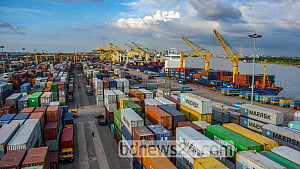
Bangladeshi businesses and entrepreneurs have imported goods worth $7.07 billion in April, marking a 21.4 percent rise year-on-year and the highest monthly total in three and a half years.
Economists, bankers, and business leaders view the rise in imports following the formation of the new government as a positive sign for the economy.
They say political stability has begun to return after the election, restoring the confidence of businesses and entrepreneurs.
As a result, imports of capital machinery and other goods have started to increase.
An analysis of Bangladesh Bank data shows that imports reached $7.59 billion in November 2022. Since then, no month had recorded imports exceeding $7 billion.
Except for a few months, monthly import spending mostly remained between $5 billion and $6 billion.
Imports amounted to $5.83 billion in March, but jumped sharply to more than $7 billion in April.
During the first 10 months of fiscal year 2025–26 (July–April), Bangladesh imported goods worth $61.62 billion, which was 5.92 percent higher than in the corresponding period of the previous fiscal year.
Bangladesh Bank data show that imports of capital machinery, one of the key drivers of investment growth, increased by 12.5 percent during the July–April period.
Imports of capital machinery totaled $2.69 billion during these ten months, compared with $2.39 billion during the same period of the previous fiscal year.
Imports of intermediate goods for industry increased by 8.23 percent, reaching $54.50 billion, compared with $50.35 billion in the same period a year earlier.
Intermediate goods are raw materials or components that are processed further to produce finished products.
These goods play a vital role in production and exports across various sectors in Bangladesh, including plastics, ready-made garments, jute, and light engineering.
During the 10-month period, spending on fuel oil imports rose by 72 percent, reaching $7.64 billion.
However, imports of goods required by the country's main export sector -- the ready-made garment industry -- declined by 7.2 percent.
Spending in this sector totaled $14.56 billion during the July–April period, compared with $15.70 billion in the same period of FY2025.
To curb import expenditures amid a dollar shortage, the ousted government of Sheikh Hasina had taken various measures, which helped reduce import spending significantly.
The subsequent interim government led by Muhammad Yunus has largely followed the same approach.
After the fall of Hasina’s government in August 2024 amid a student-led mass uprising, economic instability and uncertainty persisted during the interim administration.
However, according to former World Bank Dhaka office chief economist Zahid Hussain, conditions have started to improve since the February election.
He told bdnews24.com: “Because of instability and uncertainty, many investors had been holding back and waiting for a favorable environment. Now that such an environment is emerging, they are making new investment plans and taking initiatives to establish and expand industries.”
He believes this is why imports of capital machinery, industrial raw materials, and other goods have begun to rise.
Mustafizur Rahman, distinguished fellow at the Centre for Policy Dialogue (CPD), also believes the increase in imports of capital machinery, and industrial raw materials reflects growing investment activity.
He said, “The new government has completed four months in office. The start has been encouraging and has generated optimism. The finance minister has already presented the budget, which includes initiatives to boost investment and accelerate economic growth. Bangladesh Bank has announced a Tk 600 billion incentive fund for this purpose.”
“Entrepreneurs will be able to obtain low-interest loans from this fund. Overall, there are signs that investment is increasing, and that is likely driving higher imports.”
He added, “Another two or three months of data will provide a clearer picture. Foreign exchange reserves are now at a reasonably satisfactory level. Even if imports continue to rise, it should not create major problems.”
Former chairman of the Association of Bankers, Bangladesh (ABB) and Managing Director of Mutual Trust Bank Syed Mahbubur Rahman also sees positive signs in the country's economic indicators.
He told bdnews24.com, “The dollar shortage has eased. Foreign exchange reserves are growing. Allowing the exchange rate to be determined by the market was a good decision.”
“The increase in imports of capital machinery and industrial inputs is a very positive sign. It suggests that the slowdown in investment is beginning to fade. As investment increases, the economy will gain momentum.”
At this stage, Anwar-Ul-Alam Chowdhury Parvez, President of the Bangladesh Chamber of Industries, emphasised the need to reduce bank lending rates.
He told bdnews24.com, “No entrepreneur can realistically expect to make a profit by establishing or expanding an industry with loans carrying an interest rate of 16 percent. Therefore, it is essential to ensure that interest rates come down.”