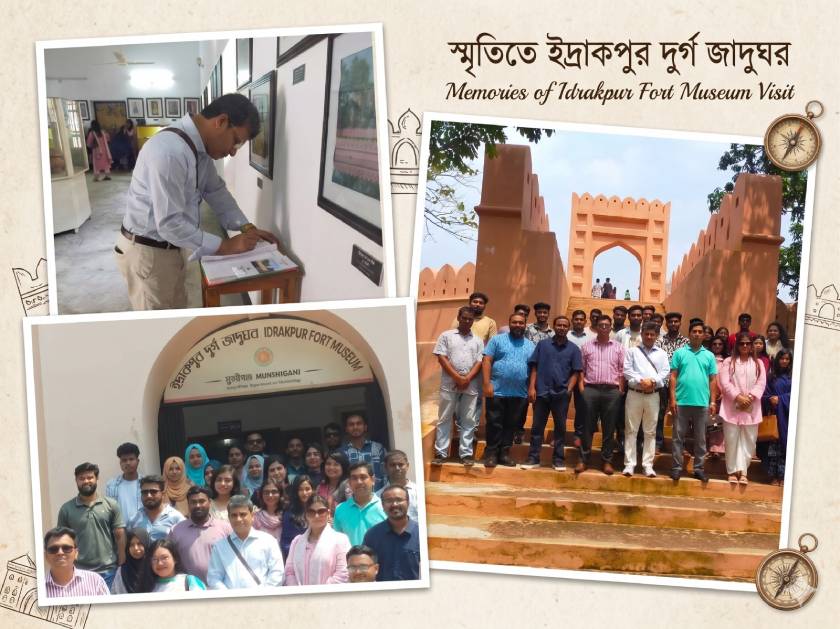
Now a days, the traditional classrooms often fail to capture the multifaceted, living essence of political science. For latest GEN students, Politics or other Social Sciences disciplines at University level, education is an active and sensory process. Last month, our study tour to Munshiganj served as an example of how historical, political, and archaeological exploration can transcend academic boundaries to foster a deeper understanding of statecraft and societal evolution.
A Journey Through TimeThe expedition was meticulously curated to traverse different epochs of governance and cultural synthesis. The sites chosen were selected as primary sources of historical evidence:
 Idrakpur Fort:
 Constructed in 1660 under the supervision of Mir Jumla, the Subahdar of Bengal, this river fort is a masterclass in military architecture designed for territorial defense against Magh (Arakanes) and Portuguese pirates.
Baba Adam’s Mosque: A testament to the pre-Mughal architectural style, this site offers a complex narrative of Islamic governance intertwined with the indigenous aesthetic sensibilities of medieval Bengal.
The Legacy of Atisha Dipankara: Visiting the home of the great Buddhist scholar provided students with a perspective on the transnational intellectual connectivity of the region, emphasizing that Bengal has been a hub of global discourse for over a millennium.
Info graphic: The Political Dimensions of Archaeological Sites
Bridging Theory and Reality: The OBE Framework
Drawing upon the higher cognitive levels of Lorin Anderson and David Krathwohl's Revised Bloom’s Taxonomy, five Course Learning Outcomes (CLOs) have been established here. Through this process, students will not merely visit historical sites; rather, they will learn the comparative 'Applying' of Mughal geopolitics to contemporary state systems, engage in 'Analyzing' the Oriental philosophy embedded in Baba Adam’s Mosque and Atish Dipankar's legacy, practice critical 'Evaluating' regarding the current preservation policies of the Idrakpur Fort archive, ‘Synthesizing’ the field insights into strategic plans. In the ultimate stage of knowledge construction, they will comprehend the socio-economic crises of the marginalized fishermen within the Padma river's Hilsa economy and engage in 'Creating' a new public policy proposal.
This 3000-4000 word research-driven report for students is logically structured into five chapters. It systematically progresses from an introduction and background to political and strategic analysis, Oriental philosophy, and public policy, culminating in socio-economic observations. To ensure a transparent and scientific measurement of this entire learning process, a precise 50-mark assessment rubric has been formulated. Ten marks are allocated to each of the five assessment criteria: theoretical connection, critical analysis, evaluation capability, creativity (policy formulation), and referencing and formatting- thereby ensuring the absolute qualitative standard of higher education.
By the banks of the Dhaleshwari and Padma, the "text" of political history became a tangible reality. Students witnessed how geography dictates politics- a fundamental tenet of geopolitics that is often abstract when discussed in a classroom setting.
The Necessity of Experiential Learning
Educational theorist David Kolb’s model of Experiential Learning emphasizes that knowledge is created through the transformation of experience. In the field, our students were forced to act as researchers rather than passive recipients of information. When they stood within the thick walls of the Idrakpur Fort, they were not just looking at bricks; they were analyzing the survival strategies of a regional administration under external threat.
This immersive approach is essential for cultivating critical thinking. In a rapidly evolving political climate, students must develop the agency to question, analyze, and eventually contribute to the national narrative. When history is experienced in situ, the abstract concepts of "sovereignty," "pluralism," and "governance" are no longer vocabulary words- they become real-world phenomena.
Breathing Life into the Future
As educators, our primary mission is to bridge the gap between classroom theory and the reality of the field. This study tour to Munshiganj served as a reminder that the most profound lessons are often found where history breathes and the future finds its roots. By stepping out of the four walls of the class rooms, our students have not only learned about the past but have also equipped themselves with the tools to critique and shape the future of Bangladesh's socio-political landscape. As we continue to integrate field-based research into our curriculum, we remain committed to the belief that the next generation of policy analysts and public administrators must be as comfortable in the field as they are in the library.