Summary

  • Donald Trump says the US agreement with Iran will be signed "shortly" and could be done tomorrow, as US officials reveal details of the deal

  • The 14-paragraph agreement says Iran will never have a nuclear weapon, and also commits to a $300bn fund for the "reconstruction and economic development" of the country - although the US is not required to contribute

  • The agreement declares the "immediate and permanent termination of military operations on all fronts, including in Lebanon"

  • And it says the US and Iran "commit to negotiating and achieving the final deal in maximum 60 days, extendable with mutual consent". Read the key points of the deal here

  • Donald Trump earlier warned the deal - which was scheduled to be formally signed on Friday - is "not final"

  • He said the US could resume attacks if the agreement doesn't work out - "If they don't behave, we'll go right back to dropping bombs right smack in the middle of their head, OK?"

  1. Analysis

    Initial deal agreed - but much work still to be donepublished at 18:54 BST
    Daniel Bush
    Washington correspondent

    Taken together, the details of the US-Iran agreement - outlined in our earlier post - confirm the narrow confines of the immediate deal at hand, as well as the massive challenges ahead for both sides to teach a permanent peace deal.

    The Memorandum of Understanding lifts the US naval blockade and reopens the Strait of Hormuz, moves that will calm the global economy.

    But it leaves all the key questions around Iran’s nuclear programme to the final negotiations.

    The Obama-era Iran nuclear deal was negotiated over nearly two years.

    Now, in theory, the US and Iran have just 60 days to reach a new one.
  2. Trump and Iranian president could sign peace deal - Iranian foreign ministrypublished at 18:39 BST
    Breaking

    US President Donald Trump and his Iranian counterpart Masoud Pezeshkian could sign the deal to end the war, Iran's foreign ministry says.

    According to semi-official news agency Tasnim, foreign ministry spokesperson Esmail Baghaei says the idea is "on the table and is still being considered".

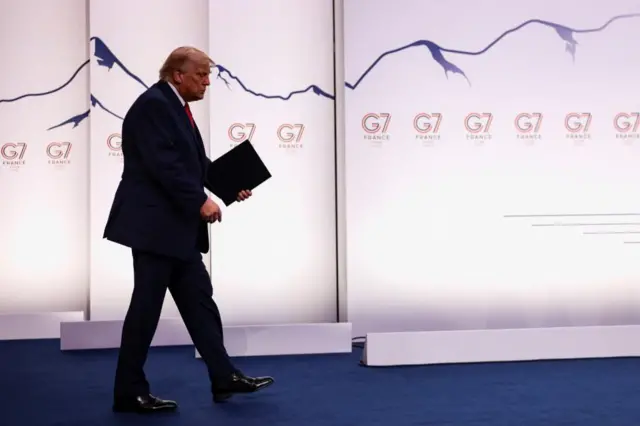
    It comes after Trump told a G7 press conference he "might" stick around for the signing ceremony, which is set to take place in Switzerland on Friday.

  3. Trump says he 'might' stay for Iran deal signing ceremonypublished at 18:21 BST

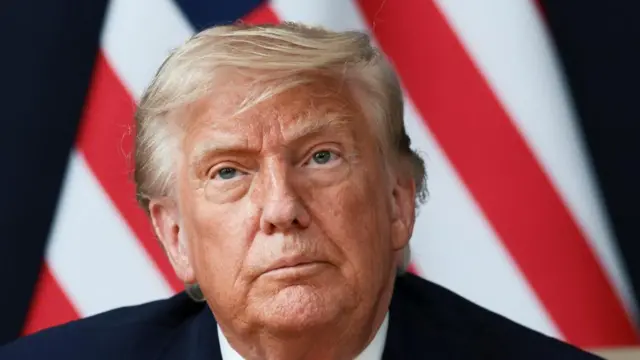
    U.S. President Donald TrumpImage source, Reuters

    Just before the G7 news conference in France wraps up, Trump is asked whether he will "stick around", as the signing ceremony is in Switzerland on Friday.

    He replies, "I might", then jokes that if the deal falls through he can blame Vice-President JD Vance.

  4. Here's what’s in the US-Iran dealpublished at 18:14 BST
    Breaking

    As Donald Trump has been speaking, senior US officials have been briefing reporters about the deal with Iran.

    The BBC was part of that meeting. Here are some key points from the 14-paragraph agreement:

    • Fighting ends - Lebanon included: The deal declares the "immediate and permanent termination of military operations on all fronts, including in Lebanon"
    • Final deal in 60 days: "The United States of America and the Islamic Republic of Iran commit to negotiating and achieving the final deal in maximum 60 days, extendable with mutual consent"
    • US naval blockade ends: The US will remove its naval blockade of Iran within 30 days. "During this period, the traffic of vessels will be in proportion to the numbers of pre-war traffic being restored by the Islamic Republic of Iran". Also, the US "further undertakes to remove its forces from the proximity of the Islamic Republic of Iran within 30 days after the final deal"
    • Strait of Hormuz reopens: The key waterway will remain toll-free for 60 days, and then, a senior official says, "Iran will work not just with Oman but with the Gulf states to set up a broader agreement, a longer term agreement on the Strait of Hormuz"
    • $300bn for Iran development: The US undertakes with regional partners to develop a fund of at least $300bn (£224bn) "for the reconstruction and economic development of the Islamic Republic of Iran"
    • All sanctions lifted: The US "undertakes to terminate all types of sanctions against the Islamic Republic of Iran", with a schedule to be agreed
    • No nuclear weapon for Iran: The US and Iran agree that Iran will never have a nuclear weapon, and they will work together on removing Iran's enriched nuclear material through "blending on site under the supervision of the IAEA"

    Our correspondents Gary O'Donoghue and Bernd Debusmann Jr have also gone through the detail - read their reports in our previous posts.

  5. Agreement says Strait of Hormuz will be toll-free for 60 dayspublished at 18:11 BST
    Breaking

    Gary O'Donoghue
    Chief North America correspondent

    The Strait of Hormuz will be toll-free for 60 days under the terms of the US-Iran deal, according to senior US officials.

    According to a senior official, the agreement between the US and Iran reads: "Upon the signing of this MoU, the Islamic Republic of Iran will make arrangements using its best efforts for the safe passage of commercial vessels with no charge for 60 days, only from the Persian Gulf to the Sea of Oman and vice versa."

    There will then be a discussion between Iran and other Gulf states and Oman, the officials said.

    According to the briefing, the agreement reads: "The Islamic Republic of Iran will conduct dialogue with the Sultanate of Oman to define the future administration and maritime services in the Strait of Hormuz, in discussion with other Persian Gulf littoral states in line with the applicable international law."

    This would open the possibility that tolls could be a reality in future.

    However, a senior US official expressed confidence that the Strait of Hormuz would remain free of tolls after these negotiations.

    Speaking to journalists, they said: “Of course, I'm sure the Iranians will assert their rights as aggressively as they can, but fundamentally [the deal is] toll-free passage of the Strait of Hormuz for 60 days. That will continue because the Persian Gulf states will never agree to an arrangement that doesn't permit toll free access to the Strait of Hormuz for themselves and their industries.”

  6. Officials say MoU does not commit US to 'anything'published at 18:10 BST
    Breaking

    Bernd Debusmann Jr
    White House reporter

    We've just wrapped up a call with senior US officials, who read out the full text of the US-Iran Memorandum of Understanding (MoU), word-for-word, along with what one official called "colour commentary".

    The officials made clear - as they have in recent days - that the US sees this agreement as performance-based, committing the US to "nothing" unless Iran meets its own obligations.

    Notably, the sixth point of the MoU says the US and regional partners will develop a "definitive, mutually agreed plan" worth at least $300bn (£224bn) for reconstruction and economic development in Iran.

    The final mechanism will be agreed within 60 days of the final deal, and all licences, waivers and permissions will be granted by the US.

    However, this does not mean the US will be financially involved.

    One official noted that the US is not required to pay "a cent of money" to Iran, or contribute.

    As a hypothetical example, the official said that if Iran "behaves", Emirati authorities could build a power plant in Iran, with US blessing.

  7. Trump threatens to bomb again if Iran does not stick to the dealpublished at 18:07 BST

    Trump says he'll "bomb the hell" out of Iran if it doesn't stick to the agreement.

    His threat came in response to a journalist's question about whether the deal includes anything enforceable to stop Iran from getting a nuclear weapon.

    Trump says military action is the only plausible path.

  8. Trump says Iran gets reconstruction fund 'only if they are doing things right'published at 17:56 BST

    Trump is now taking questions from reporters.

    He is pressed on reports that the US could allow Iran to make money by selling oil and accessing a $300bn (£224bn) reconstruction fund.

    "Only if they're doing things right," he responds.

    Trump goes on to say Iran "will be hit again" unless they "behave themselves".

  9. BBC Verify

    Was Obama deal 'going to give' Iran a nuclear weapon?published at 17:52 BST

    By Tom Edgington

    Donald Trump has claimed that the 2015 nuclear agreement negotiated under former president Barack Obama was "a deal that was going to give them [Iran], legally, a nuclear weapon".

    However, the Joint Comprehensive Plan of Action (JCPOA) explicitly stated that "under no circumstances will Iran ever seek, develop or acquire any nuclear weapons".

    The JCPOA placed restrictions on Iran’s enrichment of uranium, a key component of a nuclear weapon, requiring international monitoring.

    Both the International Atomic Energy Agency and the US State Department said in April 2018 Iran was "fully implementing" the agreement, weeks before Trump withdrew from it.

    Trump also claimed the deal “expired long ago". While it is correct that limits on Iran’s uranium enrichment level and stockpile size were only set for 15 years, these were not due to expire until 2031.

    JCPOA critic Jacob Olidor, from the America First Policy Institute, argues these "sunset clauses" meant Iran could have eventually expanded its nuclear programme.

    But JCPOA chief negotiator Cathy Ashton argues it stopped Iran from developing a nuclear weapon, telling BBC Verify if Trump felt that the deal was inadequate, "the answer was to build on it, not to rip it up".

  10. Lebanon is 'something we will have to work on', Trump sayspublished at 17:49 BST

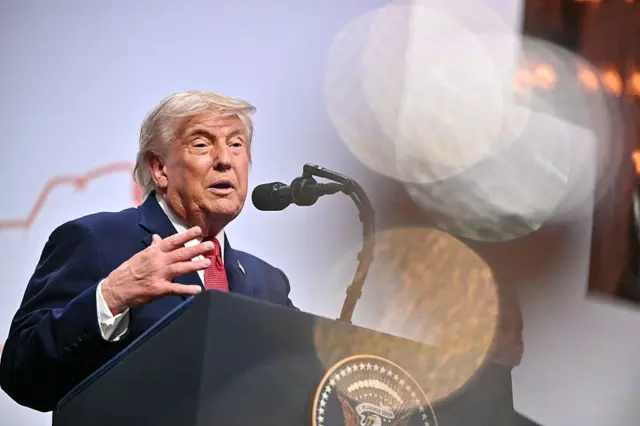
    Donald Trump speaking at a podiumImage source, AFP via Getty Images

    Trump continues to speak about the memorandum of understanding with Iran.

    He says he hopes the agreement will also be the start of a "deal all across the Middle East".

    Trump adds that peace in Lebanon is "something we will have to work on", but says "the big deal is the Iran deal".

    It's been unclear whether Lebanon is included in the deal.

  11. Trump says US will not give Iran moneypublished at 17:38 BST

    Trump moves on to US media reports that Iran could be given access to a reconstruction fund worth $300bn (£224bn) as part of the deal to end the war.

    He describes the reports as "fake story".

    "We don't give them money," he says. "We don't give them any of that."

    He then pivots to the future negotiations, which he says will involve Gulf nations and discuss "non-nuclear issues", including Iran's "conventional ballistic missiles".

    "They have to have some because other people have some, you've got to have some," Trump says.

    The president says he was advised to prevent Iran from having any missiles but he says "it doesn't work that way".

  12. Trump says Iran deal could be signed tomorrowpublished at 17:32 BST

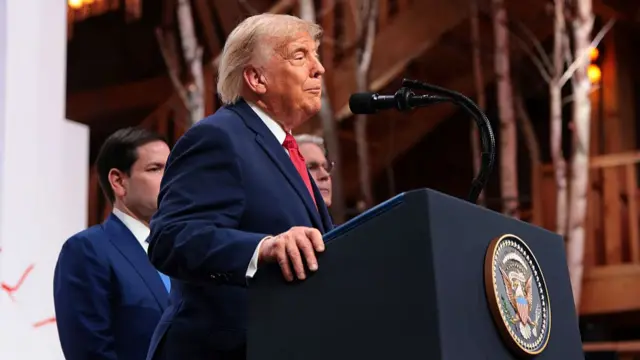
    Donald TrumpImage source, Getty Images

    Trump says the peace deal with Iran will be signed "shortly".

    "Tomorrow, maybe the next day," he says at his G7 news conference. Earlier, Trump said the deal would be formally signed on Friday in Switzerland.

    "Importantly, Iran has agreed it will neither produce nor procure a nuclear weapon," Trump says, adding that the language is important because it prevents Iran from buying nuclear weapons from other countries.

    He says a copy of the deal was sent to Israel, a "good partner", although he adds: "I think they could do better with respect to Hezbollah."

  13. Trump calls Netanyahu 'good man' but says he gets 'a little excited sometimes'published at 17:25 BST

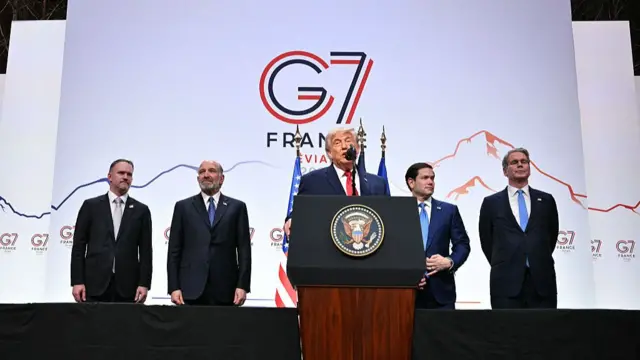
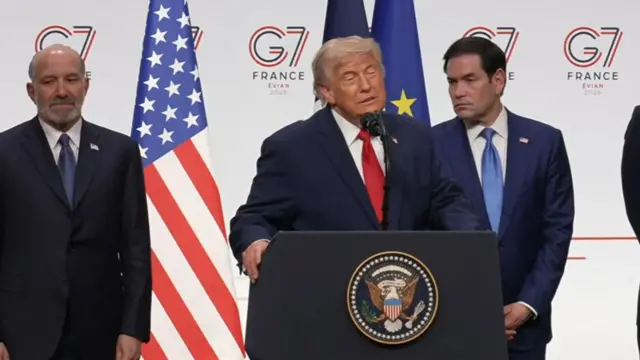
    Donald Trump speaking at a podium at the G7 Summit with senior administration officials behind him including Marco RubioImage source, AFP via Getty Images

    Trump runs through the history of US relations with Iran, referencing the 2020 strike that killed top Iranian general Qasem Soleimani.

    He also criticises the Obama administration's nuclear deal, the Joint Comprehensive Plan of Action (JCPOA), which he says "was a road to a nuclear weapon" - we'll have more on this later.

    He then turns to Israeli Prime Minister Benjamin Netanyahu, who he has expressed frustration towards in recent days. Trump calls him a "good man" but says he gets "a little excited sometimes".

    Netanyahu could do with "a little softer touch", Trump says, adding: "You don't have to knock down a building every time someone walks into it that's from Hezbollah."

  14. Analysis

    Donald Trump's complex relationship with the G7 takes another turnpublished at 17:20 BST

    Bernd Debusmann Jr
    White House reporter

    Donald Trump has just said it has been "one of the most successful" G7 summits.

    The US president has had a long and often complicated relationship with the G7 - stretching back to the start of his first term in office.

    The summits he attended in his first term were filled with tension, driven by his initial push for tariffs and an “America First” foreign policy that upset once-close allies. Some even described the group as “G6+1” - with the US as the pseudo-outcast.

    Those tensions have continued into his second term, fuelled by US frustration over a perceived lack of help during the war in Iran and a belief among allies that US support for Ukraine was wavering.

    Within this context, the pledge of the G7 this year - including the US - to help Ukraine with stronger air defences, energy and fresh sanctions as the war with Russia continues will be seen as a victory for a group that has not always seen eye to eye.

  15. 'I think that's regime change' - Trump says on Iranpublished at 17:17 BST

    Donald Trump speaking at a podium at the G7 Summit in FranceImage source, Getty Images

    Trump starts the news conference by thanking President Macron for welcoming him to France, saying it has been "one of the most successful" G7 summits.

    He says the summit comes after the signing of a peace deal that ends the current war in the Middle East, opens the Strait of Hormuz and prevents Iran from obtaining nuclear weapons.

    Trump adds that Iran now has a new group of leaders who are "smarter" and "far less radicalised", saying he has achieved regime change.

    "You talk about regime change, nobody will say that, but I guess it is," he says. "One set of leaders is all gone, the second set of leaders is all gone. Their third set of leaders is a little bit gone... I think that's regime change."

    He then talks about the movement of the stock market in relation to the peace agreement.

  16. Trump news conference beginspublished at 17:01 BST
    Breaking

    Donald TrumpImage source, Reuters

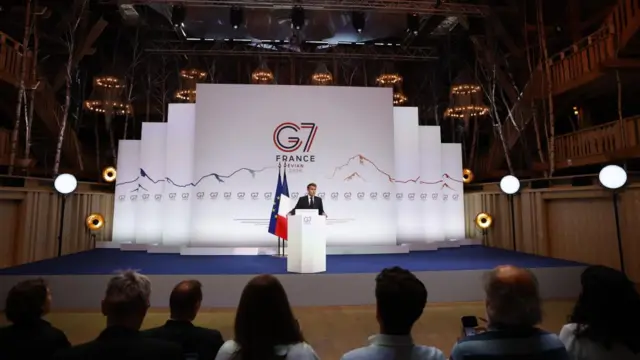
    Donald Trump has started speaking at the G7 summit in France.

    You can watch live at the top of the page.

  17. Trump news conference appears to be delayedpublished at 16:57 BST

    We're still waiting to hear from US President Donald Trump, who said he'd be speaking at a news conference this afternoon.

    Earlier, he posted on his social media platform Truth Social that he would be speaking "in 45 minutes", which would have been 15:45 BST (14:45 GMT) - more than an hour ago.

    There's been no update yet on when the news conference might happen.

    The US president has, however, spoken extensively to journalists at his earlier bilateral meetings with other leaders.

  18. Trump says US considering reimposing sanctions on Russiapublished at 16:52 BST

    Donald TrumpImage source, Reuters

    As we've reported, Emmanuel Macron has said Trump has "taken note that there is no serious will on Russia's side for peace".

    Just before Macron spoke, Trump was asked by journalists whether he thought Russian President Vladimir Putin was more responsible for the Ukraine war. He replied that he didn't want to get into that, as it could risk jeopardising a potential peace deal.

    But Trump has also told journalists that the US is considering whether to reimpose sanctions on Russia.

    "We're looking at that," he said.

    The US has suspended sanctions on Russian oil in an effort to bring down global energy prices, which soared as a result of its war with Iran. Oil prices fell recently after the two sides agreed a deal.

  19. Italian and German leaders hail G7 success after reaching agreement with Trumppublished at 16:28 BST

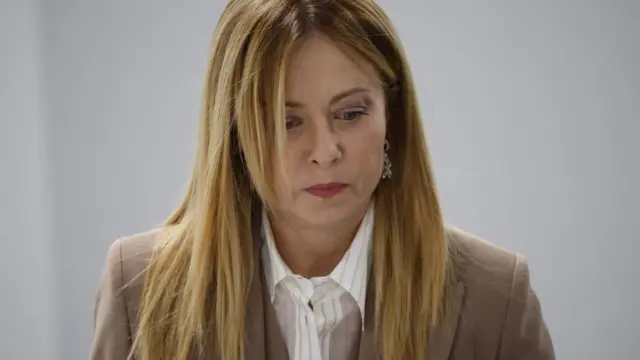
    Italy's Prime Minister Giorgia MeloniImage source, EPA

    Speaking on the sidelines of the G7 summit, Italian Prime Minister Giorgia Meloni says reaching an agreement with Trump over Ukraine at the summit is a win for Europe, as his support in this area cannot always be taken for granted.

    Meloni also says she will propose that the EU puts forward a single negotiator for Ukraine. US envoys have previously communicated with Russia directly without EU representation.

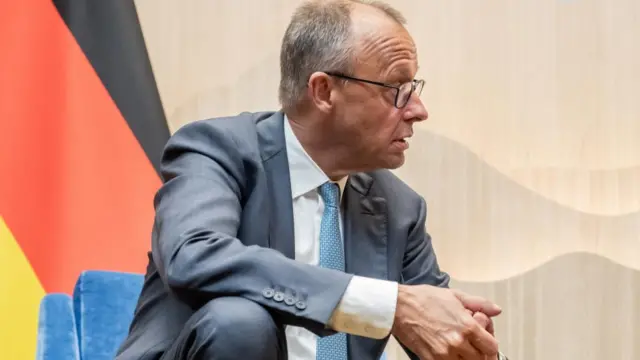
    German Chancellor Friedrich Merz has also described the joint declaration made by G7 leaders at the summit in Evian-les-Bains as a "real success".

    The chancellor notes that it is "the first time since US President Trump took office that we have issued a joint declaration at a G7 summit and found common language on the major foreign and security policy issues of our time".

    "I consider that a real success," he says.

    German Chancellor Friedrich MerzImage source, Reuters
  20. Trump sees no Russian will for peace, Macron sayspublished at 16:12 BST

    French President Emmanuel MacronImage source, EPA

    More from Macron's news conference.

    Macron is asked whether the G7 summit showed a change in attitude from Trump on Ukraine, and if he can actually trust the US president to follow through on commitments to support Kyiv.

    The French president says he welcomes US efforts to negotiate with Russia to end the war, but that so far "nothing has come back" from the Kremlin.

    "President Trump, like the rest of us, has taken note that there is no serious will on Russia's side for peace," Macron says.

    • That brings Emmanuel Macron's news conference to a close. We're expecting Donald Trump to speak soon - stay with us