I wake up to the slight rain taking place outside, and a cool gust of wind wakes me up further. My phone screen greets me; it's currently 11:30 am. I had to get ready to go out as I had an agenda to try to visit every spot in the city (which frankly is impossible) as after yesterday's late night realisation I came to the unfortunate conclusion that I knew next to nothing about the places that made up Dhaka, my place of origin, I couldn't help but feel guilty hence to rectify I impulsively decided it was time to go hit up a few places and learn about the millennials of history alongside it.
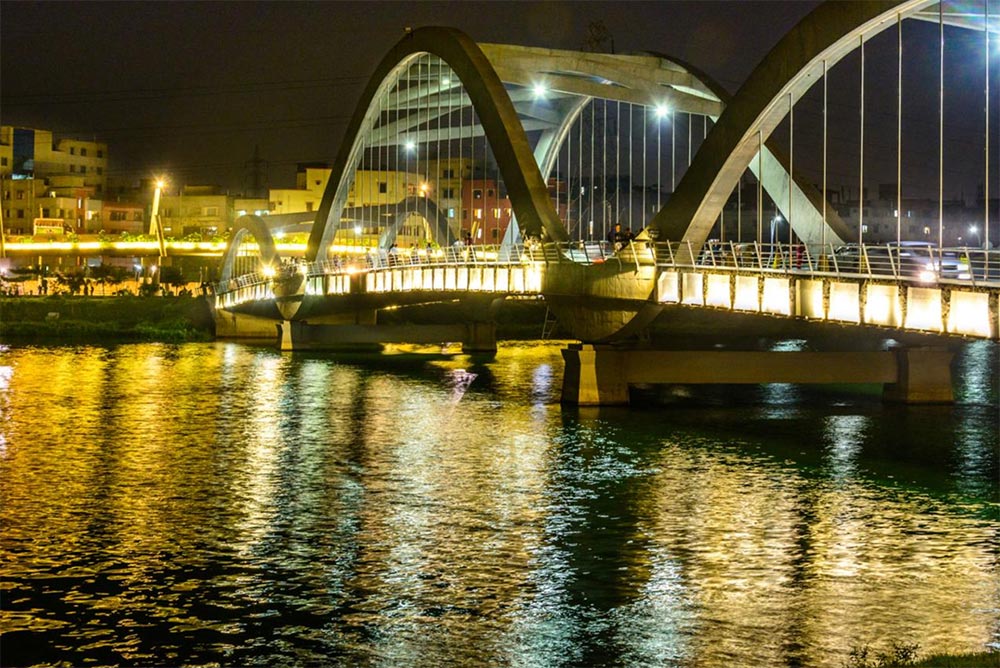
I finally stepped outside. It's 12:45 pm. I take a deep breath and look out the window of my car, the gentle hum of the engine mingling with the sounds of the city outside. A soft breeze flows by, rustling my hair around as I lower the window a little more. I look at the road ahead. Hatirjheel. The gleaming lake greets me; some people are leaning by the bridge, while others are giggling on their phones. Everyone seems to be at peace, thanks to the calm flow of the lakefront. Hatirjheel was initially an area in the 19th century where elephants from the Pilkhana were bathed (hence, the name "Elephant Lake"). Looking at the steel bridges that flow by my eyes as I move past this road, it is quite hard to imagine a time when elephants roamed around and were scrubbed clean with fresh water by their loving caretakers. Hatirjheel is connected to different intersections of the city, so out of spontaneity, I tell the winds to take me wherever they desire.
Soon, with the breeze guiding me, I arrive at Khilgaon after about thirty minutes, which is quick by Dhaka standards. The bustling street awakens me a little bit. The air is smoky and dense, thick with the aroma of spicy roadside shingaras and the distinct scent of exhaust fumes. Vibrant cloth banners hang above crowded sidewalks, their colours faded but still catching the late afternoon light. Shops are calling out to passersby to look at them once, to buy from them, their owners' voices blending with the melodic honking of rickshaw bells and the chatter of vendors announcing fresh fruits. I catch the sizzle from a nearby tea stall, and the earthy smell of wet dust rises from a truck that just sprayed the road. Everyone seems to be ignoring each other and going on their way. During the 17th century, Khilgaon was a busy trade hub alongside the Pandu River. Later on, it was acquired by the powerful Chowdhury family, hence its infamous name of "Chowdhury Para". The name "Khilgaon" was derived from Bengali, wherekhilrefers to uncultivated land and gaon means village, reflecting its rural origins. It seems as if the current Khilgaon still holds onto its earliest identity of being a trade hub. The dust and heat of the city are now part of my being, of my blood, so I don't flinch when I notice an onslaught of pollution blinding the roads ahead of me.
As the winds shift, I move on and reach Motijheel, the 'Lake of Pearls,' after almost 45 minutes. I cannot help but notice the awe-inspiring buildings surrounding me. It intimidates me in a way where I imagine myself amongst the thousands of dull office workers going to their respective places of employment. I feel a little lost by how fast-paced everything seems here. Motijheel is the primary central business district and also the nation's largest commercial and financial hub. It is also named "bankpara" or "neighbourhood of banks" because of the overflow in the number of banks situated here. Motijheel has a profound part in the history and establishment of Bangladesh.
The area was historically known as Dilkusha. It was the site of the Dilkusha, Dhaka Gardens, a property of the Nawab of Dhaka. The area became home to an official residence of the governor of Bengal and the viceroy of India. It later became the seat of the Governor of East Pakistan. Motijheel now carries the title of the current tallest building in Bangladesh, as the famed City Centre of Dhaka is located here. The 37-storied building loomed over me; thousands of people were exiting and entering at once; I was stuck in one place for a while, but I had to get moving.
Another 30 or so minutes later, I came face-to-face with the upscale residential neighbourhood that is Bashundhara. Bashundhara has been a mystery to me because of how larger than life it seemed sometimes. It is sometimes also described as "a city inside a city", and it truly lived up to its name. I could slowly feel myself getting warped into the vortex of the sheer amount of buildings and housing all around me. Bashundhara was not always this prim and proper, as back in the 1980s, it had been a low-lying marshland and flood flow zone. Now, more than 10,000 residential plots have been sold since the early 2000s. Bashundhara is also home to multiple institutions and hospitals. It is one of the more developed parts of Dhaka, and I could truly feel it around me; a slight wind was picking up, and the leaves rustling calmed me down after today's expedition.
I could see people coming out of their shops and homes to go visit the mosque. A small but sure way to connect with the one who made us all. I glanced at my phone. It was almost time for me to go home.
But before the inevitable end of my journey, I wanted to visit one last place. The breeze carried a slight earthiness after today's light shower. I let it take me to Uttarkhan, a part of the city I have never had the chance to visit. It was considerably very far away and just the place I had to go to wind down. The sun had already set. A darkness enshrouded the passing roads. Uttarkhan took me an hour to get there, but when I finally arrived, I could feel the tension slipping out of my bones. Uttarkhan is a place with a lot of history. It is said that during the 17th century, Islamic preacher Shah Kabir settled in this area from a place in the Indian subcontinent named "Utrekhtan", hence the name. The area lacked proper infrastructure for many long years; however, after being incorporated into the Dhaka North City Corporation in 2017, Uttarkhan experienced significant urbanisation. It is now home to plenty of green resorts as well as housing. Nonetheless, it still maintained the essence of the countryside and greenery it once was. I took a gulp of fresh air, knowing that it was almost time to return.
My last spot to visit in today's agenda happened to be my home. A place I couldn't change for the world. I was already missing my bed and the neighbours who couldn't stop talking until the sun rose. I stepped inside my humble abode. The familiar scent of my haven welcomed me back. Home sweet home.





