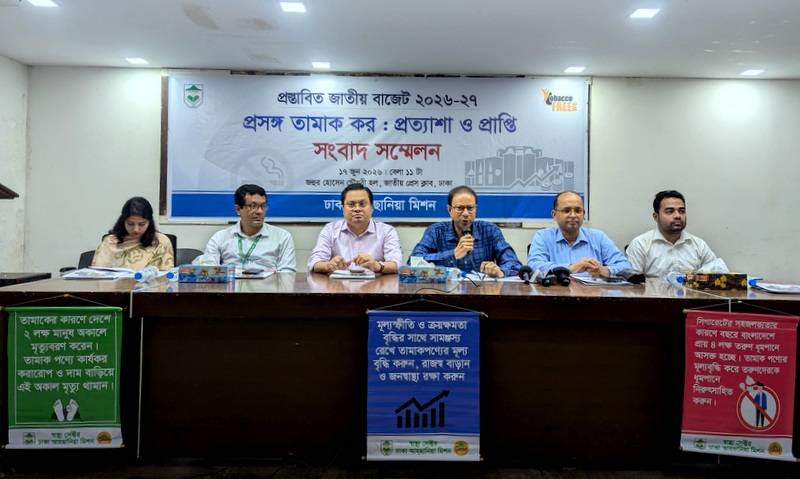
The proposed national budget for FY2026-27 fails to introduce a tobacco tax and price structure capable of achieving the twin objectives of protecting public health and increasing government revenue, experts said at a press conference on Wednesday.
They warned that the marginal increase in the price of low-tier cigarettes, coupled with unchanged prices and tax rates for bidis, zarda and gul, would effectively lower the real prices of these products, making them more affordable and encouraging greater tobacco consumption, particularly among young people and low-income groups.
The observations were made at a post-budget press conference organized by Dhaka Ahsania Mission at the National Press Club on Wednesday following the announcement of the national budget for FY 2026-27.
The event was addressed by Masudul Haque, President of the Bangladesh Secretariat Reporters Forum; MM Badsha, General Secretary of the Crime Reporters Association; and Iqbal Masud, Director of the Health Sector of Dhaka Ahsania Mission. The keynote paper was presented by Shariful Islam, Coordinator of the Tobacco Control Project.
The speakers noted that nearly 75 per cent of the country's cigarette market is dominated by low-tier brands, primarily consumed by poor and young people. Under the proposed budget, the retail price of a 10-stick pack of low-tier cigarettes has been increased by only Tk 2 to Tk 62, representing a mere 3.33 per cent rise. As both per capita income growth and inflation have outpaced this increase, the real price of low-tier cigarettes will decline, making them more affordable and likely increasing consumption.
They further stated that if the government merged the low and medium cigarette tiers, set the retail price at Tk 100 per pack of 10 sticks, imposed a specific supplementary duty of Tk 4 per pack, and increased the prices of all tobacco products, it could generate nearly Tk 44 billion in additional revenue compared to the current fiscal year. Such measures could also prevent approximately 400,000 premature deaths in the long run.
Although the prices of medium, high and premium cigarette tiers have been increased to some extent, the speakers said, no fundamental reform has been introduced in the tobacco tax structure. Consequently, a significant portion of the price increase will translate into additional profits for tobacco companies and may be used to further expand their businesses, posing a serious threat to public health.
The proposed budget also leaves the prices and tax rates of bidis, zarda and gul unchanged, making these products cheaper and more accessible in real terms and increasing health risks, particularly among women and low-income populations. Furthermore, by imposing taxes on nicotine pouches and heated tobacco products without considering the Ministry of Health's recommendation to ban them, the government has effectively legitimised these emerging products, creating the risk of a new wave of nicotine addiction.
The speakers noted that more than 35 per cent of adults in Bangladesh use tobacco and that nearly 200,000 people die every year from tobacco-related diseases. The annual economic cost of tobacco-related health and environmental damages is estimated at around Tk 870 billion.
The government has already enacted the Amended Tobacco Control Act 2026, and the Head of Government has repeatedly expressed her commitment to protecting children, adolescents and young people from the harmful effects of tobacco and nicotine products.