Share-Market
DSE awards FIX certification to 3 more brokerages
The Dhaka Stock Exchange (DSE) on Wednesday issued FIX (Financial Information Exchange) certification to three more brokerage houses, bringing them closer to launching their own Order Management Systems (OMS) through API connectivity with the exchange's Nasdaq matching engine.
The certificates were handed over at a ceremony by DSE Chief Financial Officer Md Abid Hossain Khan to representatives of GMF Securities Limited, Prime Islami Securities Limited, and Unicap Securities Limited.
Head of IT at GMF Securities Lubna Mahmud, CEO of Prime Islami Securities Md Rajib Hasan and Unicap Securities CEO Waliul Islam received the certificates on behalf of their organisations.
DSE Deputy General Manager Jisan Bin Mubarak and Assistant General Manager Kamrun Nahar, along with other senior officials, were present at the event.
With the latest batch, DSE has now certified a total of 61 brokerage houses under the FIX protocol. Of these, 53 have already gone live with their own OMS platforms, conducting trading operations via API integration with the exchange.
DSE had initiated the API-based Broker House Order Management System (BHOMS) programme in 2020. Following that, 85 brokerage houses applied to DSE seeking API connectivity with the Nasdaq matching engine to operate their proprietary order management systems.
2 hours ago
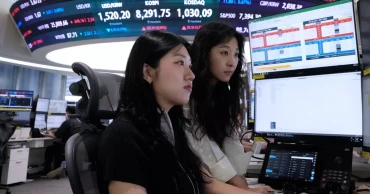
Iran deal sparks stock rally, eases oil prices
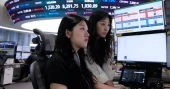
Share prices soared Monday in Asia after a tentative deal was announced on ending the Iran war and reopening the Strait of Hormuz.
Benchmarks in Tokyo and Seoul initially gained more than 5% early Monday. Oil prices fell more than $4 a barrel.
The future for the S&P 500 was up 1% and that for the Dow Jones Industrial Average gained 0.9%, auguring likely early gains for Wall Street.
U.S. President Donald Trump confirmed the initial agreement and authorized an end to the U.S. naval blockade of Iranian ports.
Iran confirmed it but signaled that implementation would not start until a signing that Pakistan said would be held Friday in Switzerland. Broader negotiations on issues like Iran’s nuclear program are expected to continue over the next 60 days.
In early trading Monday, the price of Brent crude oil, the international standard, fell $3.61 to $83.64 per barrel. U.S. benchmark crude lost $4.27 to $80.61 per barrel.
But it may take months for oil prices to stabilize after the disruptions from the war caused them to surge, pushing costs up gasoline and many other products. Energy experts said shipping and insurance companies will want to be confident the pact will hold, ensuring that oil and gas supplies will flow freely enough for the world’s needs to be met.
“Markets are likely to be cautious in not over-extending optimism as they watch for an actual resumption of traffic across Hormuz,” Mizuho Bank analysts said in a commentary.
Still, the news was a huge relief for markets that have been roiled since the conflict began in late February.
The deal on ending the war offers relief to the global economy more than three months since fighting began.
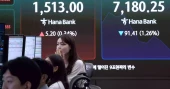
Stocks rallied in Asia, where Tokyo's Nikkei 225 gained 5.4% to 69,603.91 as the benchmark logged another record high.
Buying was heaviest for technology shares, especially those related to artificial intelligence. The boom in AI has been driving gains in Japan, where the benchmark has gained more than 80% in the last year.
“This is great news," said Takashi Hiroki, chief strategist at Monex. “Buying by foreign investors is leading the market with expectations of easing tensions around the situation in the Middle East. Then the decline in New York crude oil futures is supporting this positive market.”
The Kospi in Seoul surged 4.9% to 8,517.93.
In Hong Kong, the Hang Seng gained 0.6% to 24,867.94, while the Shanghai Composite index was up 1.1% to 4,073.08.
Australia's S&P/ASX 200 advanced 1.4% to 8,922.90. Taiwan's Taiex was up 2.5%.
On Friday, U.S. stocks as Musk's SpaceX soared in its highly anticipated debut on Wall Street.
The strong debut suggested plenty of demand still exists among investors for AI after its stock leaped 19.2% in its first day of trading. That gave Elon Musk’s rocket company a total value of $2.1 trillion, making it bigger than Exxon Mobil, Bank of America and Coca-Cola combined. In addition to building rockets, SpaceX also owns the artificial intelligence company xAI.
The S&P 500 added 0.5% to close out its 10th winning week in the last 11. The Dow Jones Industrial Average climbed 353 points, or 0.7%, and the Nasdaq composite gained 0.3%.
In other dealings early Monday, the dollar rose to 160.20 Japanese yen from 160.12 yen late Friday. The euro climbed to $1.1595 from $1.1578.
2 days ago

New BSEC chairman commits to IPO reform, digitalisation in first DSE meeting
The Dhaka Stock Exchange PLC on Sunday congratulated newly appointed Bangladesh Securities and Exchange Commission Chairman (BSEC) Masud Khan and three newly appointed commissioners, pledging full cooperation in carrying out meaningful capital market reforms.
A DSE board delegation led by Chairman Mominul Islam called on the new BSEC leadership at the commission's office and greeted them with floral bouquets.
BSEC Chairman Masud Khan said the commission has begun work with a clear action plan to make the capital market more effective, dynamic and investment-friendly. “Our primary goal will be to build a simple, transparent and effective regulatory framework by reducing unnecessary complexities.”
He said the commission will review recently enacted rules on IPOs, margin loans and mutual funds and take steps to amend them where necessary. “Full digitalisation of capital market operations and making the IPO process faster, more transparent and internationally competitive are also among the priorities.”
DSE Chairman Mominul Islam said the board and management are fully prepared to support the implementation of fundamental capital market reforms.
He stressed the need to enhance capacity in IPO valuation and market surveillance, and called for adopting a risk-based regulatory approach.
DSE Director Syeda Zakerin Bakht Nasir said effective development of the capital market requires a clear division of responsibilities and authority between BSEC and DSE, along with stronger coordination and improved decision-implementation processes.
Director Snehasish Barua called for greater accountability, efficiency and faster decision-making in IPO and rights issue processes, urging all stakeholders to play a more responsible role in protecting investor interests.
Director Richard D'Rozario highlighted the need to reassess the share category system, introduce a modern settlement mechanism and enforce the delisting process more seriously.
Director Minhaj Mannan Emon stressed the importance of strengthening the stock exchange's role in preventing irregularities in the brokerage sector and protecting investor interests in the IPO process.
He expressed confidence in the new BSEC leadership and assured DSE's full cooperation in building a transparent, modern and investor-friendly market.
DSE Managing Director Nuzhat Anwar said the exchange is making necessary preparations for introducing script netting and T+1 settlement, and is working in coordination with BSEC and Bangladesh Bank on the matter.
9 days ago

BSEC's new chairman vows market overhaul, pledges to end floor price regime
Masud Khan, the newly appointed chairman of the Bangladesh Securities and Exchange Commission (BSEC), on Tuesday promised a sweeping transformation of the country's capital market, outlining plans to scrap floor prices, crack down on market manipulation, attract foreign investment, and shift the market from retail-investor dependence to an institutionally driven, credible investment destination.
Delivering his inaugural address at a press conference at the BSEC office in Agargaon, shortly after taking charge on Tuesday afternoon, Masud acknowledged that the capital market had failed to keep pace with Bangladesh's broader economic growth and that investor confidence had been severely eroded over the years.
“Trust is not built through speeches. Trust is not built by artificially supporting the market. Trust comes from fairness, transparency, consistency and accountability,” the new BSEC chairman said.
In one of his most significant policy pronouncements, Masud declared that no floor price would be imposed on securities in the future, and that existing floor prices would be phased out in a calibrated manner based on market conditions, allowing the market to return to a natural price discovery process.
Masud set out an unambiguous vision for the regulator: to transform Bangladesh's capital market from a retail-driven frontier market into a transparent, institutionally anchored market capable of mobilising long-term domestic and international capital for the country's economic growth.
He said the new commission had assumed responsibility at a critical juncture, when many investors had suffered losses, quality companies remained reluctant to list, foreign investor participation had dwindled, and the mutual fund industry had failed to earn public trust.
13 days ago
DSE records year’s highest turnover as BSEC gets new chairman
Dhaka's stock market surged to its highest turnover of 2026 on Thursday as the capital market regulator Bangladesh Securities and Exchange Commission (BSEC) saw its outgoing chairman resign and a new one appointed on the same day.
Trading on the Dhaka Stock Exchange (DSE) hit Tk 1,351 crore by the close of the session, the highest single-day turnover this year, buoyed by renewed investor confidence following the leadership transition at the top securities regulator.
Markets began climbing in the morning after news of the resignation of BSEC Chairman Khondoker Rashed Maqsood and four commissioners spread around.
Turnover crossed Tk 1,000 crore before noon. Sentiment strengthened further during the session when Masud Khan was appointed as the new BSEC chairman, pushing activity higher through the closing bell.
The previous year-high turnover had been set just a day earlier, when DSE turnover stood at Tk 1,279 crore on Wednesday.
Positive momentum had, in fact, defined the entire week. All four trading sessions since markets reopened Monday following the Eid-ul-Azha holiday recorded gains, with the benchmark index rising on each day.
Thursday was no exception. The flagship DSEX index gained 33 points, the Shariah-based DSES rose 9 points, and the blue-chip DS30 index added 11 points.
Advancers outpaced decliners with 242 companies posting gains against 104 losers, while 45 scripts closed unchanged.
Genex Infosys PLC led the gainers with a 10 percent jump, while Jamuna Bank PLC was the top loser, shedding nearly 10 percent.
The Chittagong Stock Exchange (CSE) also closed in the green. The all-share index CASPI advanced 83 points, with 152 companies advancing against 74 declining and 29 unchanged. Total turnover at the CSE stood at Tk 27.46 crore.
13 days ago
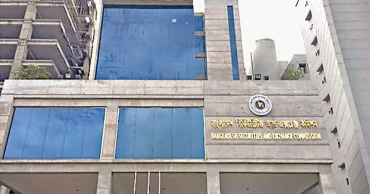
BSEC slaps Tk 2.83 cr in fines on 3 listed companies over securities law violations
The Bangladesh Securities and Exchange Commission (BSEC) has imposed a total fine of Tk 2 crore 83 lakh on directors, managing directors, and senior officers of three listed companies for securities law violations, according to a press release issued on Thursday.
The decisions were taken at the 1014th Commission meeting held on May 19, chaired by BSEC Chairman Khondoker Rasheed Maqsood.
In the first case, the Commission fined a total of Tk 1 crore 40 lakh on seven directors and officers of Khan Brothers PP Woven Bag Industries Limited for providing false information in audited financial statements for the fiscal year ended June 30, 2023, in violation of securities laws.
Among those penalised, Chairman Mohammed Enamul Kabir Khan, Managing Director Tofayel Kabir Khan, and three directors: Md. Ruhul Kabir Khan, Hazrat Ali, and Jarin Kabir Khan were each fined Tk 25 lakh.
Chief Financial Officer Md. Azizul Zabber was fined Tk 10 lakh, while Company Secretary Tapan Kumar Sarker was fined Tk 5 lakh. The fines are to be treated as personal liabilities of the penalised individuals.
In the second case, the Commission fined a total of Tk 8 lakh, Tk 1 lakh each on eight directors and current board members of Genex Infosys PLC for failing to pay a declared 3 percent cash dividend for the fiscal year ended June 30, 2024, within the stipulated timeframe, in violation of securities laws and regulations.
Those fined include Chairman Mohammed Adnan Imam, Acting Managing Director ShahJalal Uddin, four directors including Chowdhury Fazle Imam, Prince Mojumder, Oracle Services PLC, and Nilofar Imam, along with the then-CFO and then-Company Secretary.
In the third case, the Commission imposed fines totalling Tk 1 crore 35 lakh on seven directors and officials of Aftab Automobiles Ltd for failing to repay Tk 1,16,81,649.67 in outstanding cash dividends for the fiscal year ended June 30, 2024, out of a total declared dividend of Tk 7,85,95,464.68.
Chairman Shafiul Islam and Managing Director Saiful Islam were each fined Tk 30 lakh, while Director Khaleda Islam, Director Sajedul Islam, and Director Farhana Islam were each fined Tk 20 lakh.
The then-CFO was fined Tk 10 lakh and the then-Company Secretary Tk 5 lakh. The Commission also ordered the company to pay the outstanding dividend within 30 days of the order. In case of further default, an additional fine of Tk 10,000 per day will be imposed, and the company will not be absolved of its liability to pay the remaining dividends to investors.
Separately, the Commission approved the appointment of focal point and deputy focal point officers at BSEC to coordinate a nationwide investment education and safe investment awareness campaign.
27 days ago
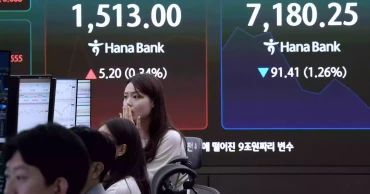
Asian markets fall as rising bond yields weigh on global stocks
Asian stock markets mostly declined on Wednesday as rising bond yields and concerns over prolonged inflation linked to the Iran war continued to pressure investors and weaken the technology-driven market rally.
Japan’s benchmark Nikkei 225 fell 1.2 percent to 59,804.41, while the yield on the country’s 10-year government bond remained near its highest level since 1997 at just under 2.8 percent. The US dollar slipped slightly against the Japanese yen, trading at 158.92 yen.
Chinese markets also ended lower, with Hong Kong’s Hang Seng Index losing 0.7 percent to 25,607.67 and the Shanghai Composite Index declining 0.3 percent to 4,156.47.
Australia’s S&P/ASX 200 dropped 1.3 percent, while South Korea’s Kospi lost 0.9 percent following a broad sell-off in the previous session. Taiwan’s Taiex index also edged down 0.4 percent.
US futures showed little movement after Wall Street recorded losses on Tuesday. The S&P 500 fell 0.7 percent for its third consecutive decline, while the Dow Jones Industrial Average lost 0.6 percent and the Nasdaq Composite dropped 0.8 percent.
Technology stocks continued to weaken after strong gains earlier driven by enthusiasm over artificial intelligence. Investors are increasingly concerned that many tech stocks have become overvalued.
Market attention is now focused on chipmaker Nvidia’s upcoming quarterly earnings report, which investors believe could influence the future direction of technology stocks and the broader US market.
Oil prices remained volatile amid uncertainty surrounding the Iran conflict and possible disruptions in the Strait of Hormuz, a key route for global oil shipments.
US benchmark crude oil fell $1.04 to $103.11 per barrel in early Wednesday trading, while Brent crude dropped $1.11 to $110.12 per barrel.
Meanwhile, rising bond yields continued to unsettle markets. The yield on the 10-year US Treasury climbed to 4.66 percent from 4.61 percent a day earlier, compared with below 4 percent before the Iran war began.
Analysts say higher yields could increase borrowing costs for mortgages and major corporate investments, including AI data center projects, potentially slowing economic growth.
Despite market concerns, several major US companies have continued to report stronger-than-expected earnings, supported by resilient consumer spending despite higher fuel prices and economic uncertainty.
28 days ago
Stock exchange to stay shut May 25–31 for Eid-ul-Azha
Dhaka Stock Exchange (DSE) and Chittagong Stock Exchange (CSE) will remain closed from May 25 to 31 in observance of Eid-ul-Azha holidays following the government's declaration of May 25 as an additional public holiday, the bourses said in a press release on Tuesday.
The government's order extends the Eid-ul-Azha vacation period by one day, prompting DSE and CSE to adjust its trading calendar accordingly.
However, in a notable deviation from the usual weekend schedule, both trading and official activities at the Exchange will remain fully operational on Saturday, May 23, and Sunday, May 24, as per regular office and trading hours, in compliance with the government directive.
Normal trading and administrative operations are set to resume on Monday, June 1, following the extended holiday break.
Market participants and investors are advised to plan their transactions accordingly ahead of the closure.
29 days ago

DSE, Swisscontact sign MoU to strengthen SME participation in capital market
Dhaka Stock Exchange PLC (DSE) and Swisscontact Bangladesh signed a Memorandum of Understanding (MoU) on Sunday aimed at strengthening the SME sector in the capital market and advancing sustainable, inclusive economic development through the country's securities ecosystem.
Senior officials from both organisations, including DSE Managing Director Nuzhat Anwar and Swisscontact Bangladesh Country Director Helal Hossain, were present at the signing ceremony.
Nuzhat said mutual coordination and a clear roadmap had enabled swift implementation of the initiative, which she believes will play a pivotal role in developing the SME sector.
She stressed the need for capacity building, corporate governance support, and compliance assistance to increase SME participation in the capital market.
Swisscontact Bangladesh Country Director Helal Hossain noted that while SME companies are a key driver of Bangladesh's economy, they continue to face significant challenges related to financing, competitiveness, and compliance.
He underscored the urgency of creating alternative financing and equity-based capital-raising opportunities for SMEs in the current economic climate, expressing hope that the partnership with DSE would serve as a catalyst in bringing promising SME enterprises into the capital market fold.
Under the MoU, both organisations will collaborate across strategic sectors including readymade garments (RMG), healthcare, and agriculture.
Joint programmes will also cover environmental, social and governance (ESG) standards, sustainability reporting, entrepreneurship development, financial inclusion, climate resilience, trade facilitation, and skills development.
The two institutions will jointly conduct capacity-building programmes, awareness workshops, incubation support, and advisory activities to encourage broader capital market participation.
Cooperation is also planned on developing sustainable finance instruments, including green bonds, sustainability-linked bonds, sukuk, and blended-finance models.
1 month ago
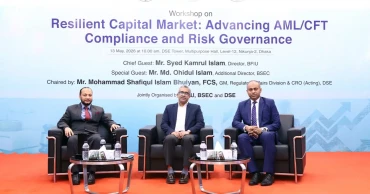
DSE, BSEC, BFIU join hands to bolster fight against money laundering
Bangladesh's key financial regulators convened on Wednesday at the Dhaka Stock Exchange PLC (DSE) to bolster the capital market's defences against money laundering and terrorist financing, underscoring growing concerns over illicit financial flows threatening investor confidence.
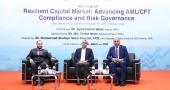
The workshop titled “Stable Capital Market: Progress in AML/CFT Compliance and Risk Management” was jointly organised by the Bangladesh Financial Intelligence Unit (BFIU), the Bangladesh Securities and Exchange Commission (BSEC) and the DSE.
Chaired by DSE General Manager and acting Chief Risk Officer Mohammad Shafiqul Islam Bhuiyan, the event brought together senior officials from all three institutions to assess implementation of anti-money laundering and counter-terrorist financing frameworks across the securities sector.
In his welcome address, Shafiqul Islam warned that the capital market now faces layered risks, from money laundering and terror financing to cyber-enabled financial crimes, insider trading and market manipulation, all of which erode investor trust and undermine sound governance of the financial system.
BSEC Additional Director Md Ohidul Islam, speaking as a special guest, stressed that effective implementation of the Anti-Money Laundering (AML) and Combatting the Financing of Terrorism (CFT) framework is indispensable for building a transparent, resilient and trust-based capital market.
He cautioned that illicit financial flows and laundering risks directly damage market integrity and pose a systemic threat to financial sector stability.
BFIU Director Syed Kamrul Islam, the chief guest, called for clearer and more actionable AML/CFT guidance for capital market participants.
A transparent, accountable and well-governed capital market, he said, plays a decisive role in attracting both domestic and foreign investors.
AML/CFT guidelines enforce strict protocols to prevent money laundering and terrorist financing, primarily focusing on risk-based approaches (RBA), Customer Due Diligence (CDD), and transaction monitoring.
Key requirements include identifying beneficial owners, conducting regular audits, reporting suspicious activities (STR/SAR), and complying with international standards, such as those from the Financial Action Task Force (FATF).
The workshop comes as Bangladesh's capital market regulators face intensifying pressure to align with international financial integrity standards ahead of upcoming FATF-related assessments.
1 month ago