














































































Padma Bridge Cuts Power Costs with Solar Energy




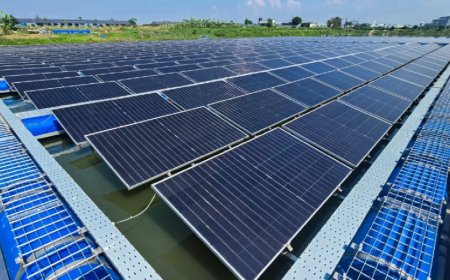
Bangladesh’s flagship infrastructure project, the Padma Bridge, has achieved a significant milestone in sustainable operations with the successful deployment of a large-scale solar power system at its Service Area-2.
A 2.49-megawatt peak (MWp) solar installation has been commissioned under a net metering arrangement, enabling the facility to generate renewable electricity while significantly reducing energy costs.
According to officials, the initiative is part of broader efforts to expand renewable energy use in line with the government's sustainability goals. The project has been implemented under the supervision of the Bangladesh Bridge Authority (BBA).
Secretary of the Bridge Division and Executive Director of the Bangladesh Bridge Authority, Mohammad Abdur Rouf, said the use of solar energy at a major national infrastructure facility such as the Padma Bridge is highly significant.
“The solar power system is not only reducing electricity expenses but is also contributing to environmental protection and lowering carbon emissions,” he said.
Net Metering Brings Major Savings
The solar facility has been connected to the national grid through a net metering system. During daylight hours, electricity generated by the solar panels first meets the power demand of Service Area-2, while excess energy is exported to the national grid.
At night or during periods of low solar generation, electricity is drawn from the grid, with consumption and generation balanced through the net metering mechanism.
As a result, electricity costs at the facility have fallen dramatically.
Data from June 2026 show that Service Area-2 received no conventional electricity bill, paying only a demand charge of Tk 75,714. By comparison, the facility’s electricity bill in May stood at Tk 521,064.
During May, the solar system supplied approximately 54,000 kilowatt-hours (kWh) of electricity to the national grid, while only 34,000 kWh were consumed from the Shariatpur Palli Bidyut network. This left the Bangladesh Bridge Authority with a net surplus of 20,000 kWh.
Expansion Underway
The Padma Bridge currently has a combined solar generation capacity of 6.03 MW across Service Areas 1, 2, and 3.
While net metering is already operational at Service Area-2, authorities are continuing work to introduce the same system at the remaining service areas.
Officials believe the project demonstrates how large-scale public infrastructure can integrate renewable energy technologies to reduce operational costs, improve energy efficiency, and support Bangladesh’s transition toward a greener energy future.
//DBTech/MAR/MI/OR//